
Battery Pack Requirements for Excavators, Loaders, and Mining Trucks
Battery Pack Requirements for Excavators, Loaders, and Mining Trucks
Electrifying off-road machinery is not a matter of replacing a diesel engine with a motor and adding the largest available battery. Excavators, wheel loaders, and mining trucks place very different demands on an energy system, yet all operate in environments where downtime, overheating, impact damage, and limited charging access can quickly undermine a project. The right Excavators, Loaders, And MiningTrucks Battery Pack must therefore be engineered around the duty cycle, vehicle architecture, site energy plan, and safety strategy—not selected on nominal capacity alone.
For fleet owners and equipment manufacturers, the central question is practical: can the battery deliver required power throughout the shift, recharge within the available operating window, remain stable in harsh conditions, and do so over enough years to make the lifecycle economics credible? A sound answer requires looking beyond kWh and considering voltage, discharge behavior, cooling, enclosure protection, controls integration, maintainability, and fire-risk management as one system.
Start With the Machine’s Real Duty Cycle
The first design input should be measured machine behavior rather than an assumed daily energy number. Excavators often combine sharp hydraulic power peaks with periods of lower demand while repositioning or waiting for trucks. A loader may repeat short, high-intensity loading cycles, with strong opportunities for regenerative energy during deceleration. Mining trucks can face sustained traction demand on uphill haul roads, followed by potentially significant regeneration on descents. These patterns determine both energy consumption and the battery’s required continuous and peak power capability.
A battery sized only for average consumption may look adequate in a spreadsheet but reach voltage limits during heavy digging, full-bucket acceleration, grade climbing, or cold-weather startup. Conversely, an oversized pack adds mass, occupies valuable packaging space, and raises capital cost. The target is usable energy that matches a defined operating window with a sensible reserve, while the cell and pack architecture can safely handle the highest expected current events.
Project teams should establish at least the following before final pack selection:
- Hours of active work, idle time, breaks, and shift changes.
- Peak hydraulic, traction, and auxiliary loads under worst normal conditions.
- Payload, material density, haul distance, gradients, and rolling resistance for transport equipment.
- Ambient temperature, solar exposure, dust, water exposure, and altitude.
- Charging windows, available grid capacity, and whether opportunity charging is operationally realistic.
- Required vehicle availability when a pack is under maintenance or being replaced.
This exercise often reveals that two machines with the same operating weight need very different battery configurations. It also prevents a common procurement mistake: comparing packs solely by rated energy while ignoring voltage compatibility and power delivery.
Capacity Must Be Usable in the Field, Not Just Rated on Paper
Nominal capacity is the starting point for range planning, but it is not the whole operating budget. The usable portion of a pack depends on the approved state-of-charge window, temperature, load profile, battery aging allowance, and vehicle control strategy. A fleet that routinely drives packs to a very low state of charge may gain short-term run time, but it also leaves little buffer for an unexpected longer cycle, a queue at the charger, or reduced energy availability in difficult weather.
For high-utilization equipment, it is generally better to define energy needs from the toughest repeatable production day, then test whether charging and standby periods can restore sufficient energy without disrupting dispatch. Mining applications deserve particular attention because a route adjustment, wet road, payload change, or longer climb can materially change consumption. The same logic applies to loaders working in stockpiles where ground conditions and bucket fill factors shift throughout the day.
Voltage is equally important. Higher-voltage systems can reduce current for a given power level, which can help manage conductor size and resistive losses. Yet the vehicle inverter, DC/DC converters, charging hardware, contactors, insulation design, and maintenance procedures must all be designed for that voltage range. The pack’s operating range—not merely nominal voltage—must align with the complete electrical system.
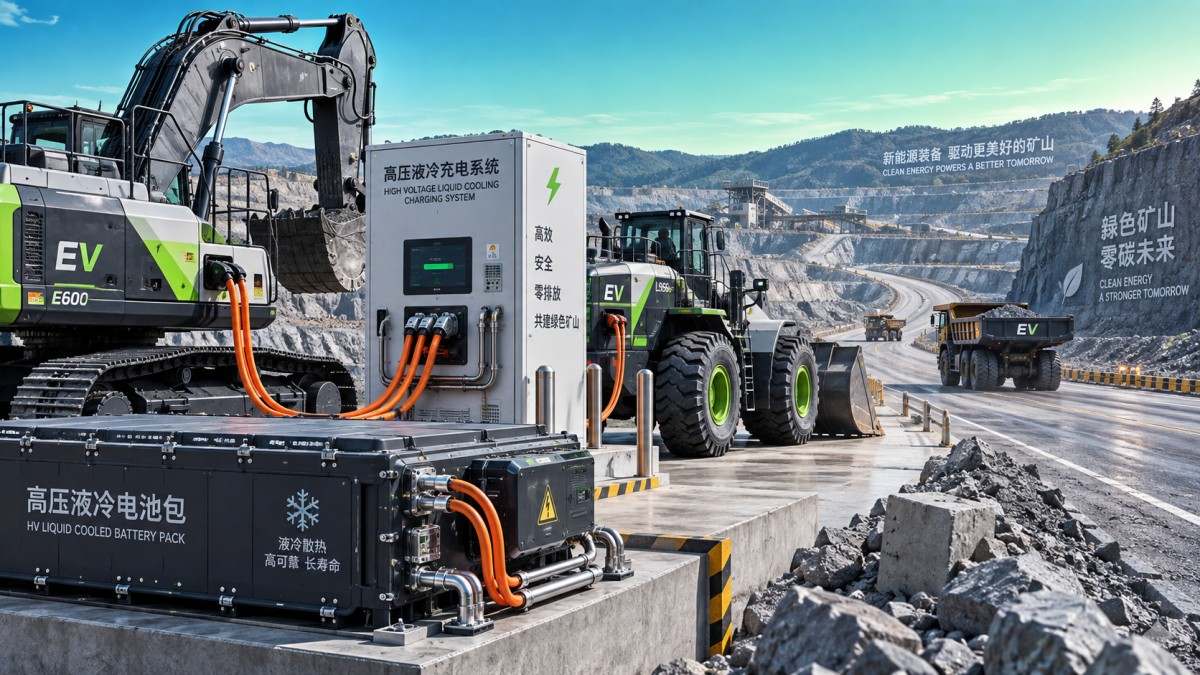
Power, Regeneration, and Charging Need to Be Considered Together
Off-road machines rarely consume power at a steady rate. Hydraulic functions can create short, intense demand spikes; heavy trucks may maintain high traction loads for long climbs; and regenerative braking may send substantial power back into the battery during deceleration or downhill travel. A suitable pack must accept and deliver these currents within its thermal and voltage limits.
Regenerative energy is valuable, but it should not be treated as guaranteed range. Its recoverable amount depends on route profile, payload, battery temperature, current state of charge, and the control system’s limits. A battery that is nearly full may be unable to accept all available regenerative power. For a downhill mining route, that is not only an efficiency question; it affects brake-energy management and vehicle behavior. The battery, inverter, and braking strategy should be reviewed as a coordinated design.
Charging selection follows from operations, not from a preference for the fastest charger. High charging power can shorten turnaround time, but it also affects grid infrastructure, heat rejection, connector requirements, cable handling, and battery life considerations. A standard charge rate may be appropriate where machines have planned breaks or overnight dwell time. In continuous operations, opportunity charging, exchangeable packs, or a larger installed energy reserve may be more workable. Each option changes the vehicle layout and site workflow.
Thermal Management Is a Productivity Requirement
Construction and mining packs live with heat from high current, external weather, hydraulic systems, motors, and charging. They also face cold starts, which can limit charging acceptance and change available power. Thermal management is therefore not an accessory feature. It is part of whether an electric machine can maintain predictable performance across a working day.
Liquid cooling is often considered for high-energy, high-power industrial packs because it can provide more controlled heat transfer than a purely air-cooled arrangement in compact vehicle installations. Still, the design must be assessed as a complete cooling loop: coolant routing, pump reliability, service access, leak detection where applicable, control logic, and behavior during a fault. A robust thermal system should manage temperature consistency across cells as well as the pack’s average temperature. Large imbalances can accelerate uneven aging and make state-of-charge estimation less reliable.
Temperature claims should also be read carefully. An operating ambient range does not mean identical available power, charging speed, or life expectancy at every point in that range. Decision-makers should ask suppliers to clarify expected derating behavior and the conditions used to define the operating limits.
The Enclosure Must Survive the Jobsite
Battery cells may be the most visible part of an electrification program, but mechanical integration often determines whether a pack survives real service. Excavators and loaders transmit shock and vibration through their structures. Mining trucks operate in dust, mud, water spray, repeated impact, and sometimes corrosive environments. The enclosure, mounting system, high-voltage connectors, harness routing, cooling fittings, and service interfaces all need to be evaluated against the actual machine location.
Ingress protection ratings provide useful information, but they should not be read as a universal guarantee. An IP rating addresses specific test conditions; it does not alone answer whether a pack mounting position is protected from stone strikes, high-pressure washdown practices, trapped mud, or long-term vibration. The fleet should define cleaning methods, expected water exposure, and likely impact hazards early, especially for underbody or side-mounted packs.
Weight and center of gravity also matter. A large pack can improve runtime but may affect axle loads, stability, lifting performance, ground clearance, and service procedures. The engineering decision is not simply “fit the largest pack.” It is to place energy storage where the vehicle remains safe, accessible, and balanced under its intended load conditions.
Safety Depends on Layered Detection and Control
For high-voltage off-road equipment, safety must cover normal operation, abnormal conditions, collision response, charging, maintenance isolation, and fire mitigation. The battery management system monitors cell voltages, temperatures, current, and other operating signals. It should communicate clearly with vehicle controls so that faults can be identified, logged, and handled in a defined sequence rather than becoming unexplained loss of power in the field.
Passive balancing can support cell-voltage consistency over time, but balancing is only one part of battery management. Procurement reviews should examine isolation monitoring, contactor logic, pre-charge behavior, emergency shutdown interfaces, fault reporting, and communications protocols. CAN is commonly important for vehicle integration, while LAN or RS485 may support certain diagnostic or system-level interfaces. The right arrangement depends on the OEM architecture and service model.
Fire protection should be evaluated as a layered response rather than a single component. Internal detection, cluster-level extinguishing measures, external firefighting access, thermal barriers, emergency procedures, and operator training each address different parts of the risk. Local regulations, site rules, insurer expectations, and vehicle-level requirements may all influence the final design. These elements need project-specific confirmation rather than broad assumptions.
A Practical Reference Point for Industrial Integration
One example of the parameters that should be examined in an industrial battery review is the ENNP-BES-418. This pack provides 418 kWh nominal capacity at 1331.2 V nominal voltage, with an operating voltage range of 1040 V to 1518.4 V. Its LFP-314 cell chemistry, liquid cooling, passive balancing battery management approach, and IP55 protection level illustrate how energy, cooling, controls, and enclosure protection are combined within one pack architecture.
The 418kWh configuration is specified for industrial applications and has dimensions of 1450 mm × 1450 mm × 2600 mm with a listed weight of 4 tonnes. Those physical values are as important as electrical ratings during vehicle feasibility work. Its stated operating temperature range is -20°C to 60°C, operating altitude is up to 2,000 m, and recommended state-of-charge usage range is 5% to 100%. The listed cell cycle life is at least 6,000 cycles at 25°C, 95% depth of discharge, and 80% end-of-life capacity; real-world lifecycle results will still depend on the application’s thermal conditions, charge profile, and maintenance discipline.
EN New Power Technology (Shandong) Co., Ltd., established in 2020 as a wholly-owned subsidiary of a listed company, works on new-energy power systems for off-road machinery as well as smart-grid energy storage solutions. For machinery programs, the value of an integrated R&D, manufacturing, and sales organization is not simply component supply. It is the ability to discuss electrical interfaces, pack packaging, thermal conditions, communication requirements, manufacturing consistency, and field-service expectations before a machine enters volume deployment.
Evaluate the Battery as Part of the Operating System
The most reliable electrification decisions are made when vehicle engineering, mine or site operations, electrical infrastructure, maintenance, and safety teams participate early. A technically capable pack can still fail an operational rollout if the charging plan creates queues, service staff lack isolation procedures, or the pack cannot be removed without excessive machine downtime.
Before committing to a configuration, validate the machine’s duty-cycle data, worst-case power demand, actual installation envelope, cooling layout, charger interface, environmental exposure, and fault-response process. For fleets transitioning from diesel, it is also wise to model what happens on the exceptional day: a delayed shift change, lower winter temperature, a longer haul route, or a charger temporarily unavailable. Those conditions, rather than nominal specifications alone, show whether an Excavators, Loaders, And MiningTrucks Battery Pack is genuinely ready for the work it is expected to perform.