
When Does a Diesel Generation and Energy Storage Hybrid System Pay Off?
A diesel generation and energy storage hybrid system pays off when the battery changes the generator’s operating pattern enough to reduce total lifecycle cost. The most favorable cases combine long hours at low or variable load, expensive fuel delivery, high penalties for outages, or a load profile with short peaks that would otherwise require a larger generator. The purchase case weakens when the generator already runs near its efficient loading range for steady, long shifts and the battery has little opportunity to cycle productively.
The financial question is therefore not whether a battery can reduce diesel use. It usually can. The question is whether the value of avoided fuel, generator wear, oversized capacity, demand exposure, and interruption costs exceeds the added capital, installation, financing, maintenance, and eventual battery replacement costs over the intended asset life.
Start with the load shape, not the generator nameplate
Average power demand is a poor starting point for a hybrid investment review. A site drawing an average of 80 kW may have a flat 80 kW load, or it may alternate between 20 kW base demand and repeated 180 kW peaks. Those two profiles can produce similar energy consumption while requiring very different equipment and producing very different savings.
A hybrid system earns its value when the battery absorbs short, high-power events and supplies low-load periods, allowing the diesel generator to operate in fewer, more efficient blocks. The generator can be switched off during quiet intervals or loaded closer to its preferred range while the battery handles rapid fluctuations. This reduces the familiar problem of a large diesel set running lightly loaded simply because it must remain available for the next peak.
Load data should be collected at a resolution fine enough to reveal starting currents, hydraulic loads, pumps, compressors, charging events, and intermittent tools. Hourly utility or fuel records are useful for annual energy totals, but they can conceal the exact peaks that determine generator sizing. A ten-minute or one-minute interval often exposes whether a battery needs high power for brief events, substantial energy for long idle periods, or both.
Three profiles deserve separate treatment:
- Low base load with sharp peaks: battery peak shaving can avoid installing or retaining a large generator that is oversized for most operating hours.
- Variable duty with long low-demand intervals: stored energy can cover quieter periods and reduce idling, provided the battery has enough usable capacity for the expected interval.
- Steady high utilization: the generator may already operate efficiently, leaving less fuel-saving headroom. A battery may still have value for resilience or grid constraints, but the fuel case alone is often limited.
A common error is to size the battery from daily energy consumption alone. Battery power rating determines whether it can shave a peak; usable energy determines how long it can carry a load; inverter overload capability determines whether it can tolerate motor starts or transient demand. A system with adequate kWh but insufficient kW will not prevent generator overload. A high-power battery with too little usable energy will shave only a few events before the generator must start.
Fuel savings require a realistic dispatch model
Diesel generators do not consume fuel in direct proportion to electrical output. They have a meaningful fixed consumption component while running, then use more fuel as load increases. As a result, a generator operating at a low fraction of its rated capacity can consume much more fuel per delivered kWh than the same unit operating nearer its efficient zone. The hybrid system’s strongest fuel argument comes from avoiding those inefficient hours, rather than assuming every battery kWh displaces the same amount of diesel.
A credible model should use the generator’s fuel curve across the relevant load range, not a single generic litres-per-kWh assumption. It should also account for warm-up, minimum run time, spinning reserve, charge acceptance, parasitic loads, and the controller’s operating logic. If the generator is scheduled to charge the battery during a more efficient operating window, the calculation must include charging losses and conversion losses before crediting the discharged energy.
The dispatch sequence matters. Consider a site with short power peaks separated by low demand. The generator can be sized for the sustained load while the battery covers the peaks. By contrast, if each peak is long enough to drain the battery, the generator will eventually carry the same load and the savings may be modest. A graph showing only the maximum demand cannot distinguish these cases.
Fuel logistics can shift the result significantly. Remote operations often bear costs beyond the invoice price of diesel: transport, site handling, storage, security, spill exposure, and time spent arranging replenishment. These should be separated in the model rather than hidden inside one assumed fuel price. Where deliveries are simple and fuel cost is low, the hybrid threshold becomes harder to reach. Where refueling requires repeated trips to an isolated site, reduced fuel volume can carry broader operating value.
Generator downsizing is valuable only when the battery is designed for the duty
A hybrid architecture often supports a smaller diesel generator because the battery provides transient power. That may reduce initial generator cost, installation weight, enclosure size, and fuel use at partial load. Yet downsizing must be tested against the longest credible high-load period, not only a typical day. A battery can support a short surge, but it cannot make sustained demand disappear.
Motor loads deserve particular care. Pumps, blowers, compactors, and auxiliary equipment may create high inrush current even when their steady-state power is moderate. Variable-frequency drives can reduce starting stress, while direct-on-line starts may demand much greater instantaneous power. The inverter, battery management system, cabling, switchgear, and protection settings all need to accommodate the actual event. A cost model that assumes peak shaving but neglects transient capability may select equipment that requires an expensive correction after commissioning.
Special-purpose mobile equipment illustrates this distinction. A road cleaning vehicle may see changing auxiliary loads from pumps, sweep systems, lighting, traction charging, and intermittent idle periods. Its route length, shift breaks, depot charging access, and duty cycle matter more than a simple daily fuel total. If high demand arrives in short bursts, storage can reduce generator peak requirements. If the auxiliary load remains elevated for most of the shift, the battery needs enough energy and recharge opportunity to justify its additional cost.
Peak-demand savings and outage costs need separate logic
At grid-connected facilities, a battery may reduce demand charges by limiting import during short peaks. This value depends on the billing method, the time window used for demand measurement, seasonal rules, and whether the peak is controllable. It should not be treated as a general reduction in energy cost. A battery discharged at the wrong time can save little, even if it cycles frequently.
For sites using diesel as primary power, the analogous benefit may be avoiding a larger generator or avoiding overload trips. These are not the same calculation. Demand-charge savings occur through reduced grid import at measured intervals. Generator deferral occurs when stored power reliably covers a peak that would otherwise set the required nameplate capacity. Both depend on load timing, but their avoided costs, risks, and verification methods differ.
Outage avoidance can be financially important, but only where the loss mechanism is defined. The relevant cost may include lost production, spoilage, restart time, damaged material, safety-related shutdown procedures, contractual exposure, or field-service mobilization. It is not defensible to assign a generic outage value without identifying the affected process and the duration the storage system can bridge. A battery designed for a ten-minute transition does not provide the same protection as one sized for several hours of autonomous operation.
Lifecycle economics should use usable capacity, not brochure capacity
Battery capacity is not fully available for every cycle. Usable energy is limited by the allowed state-of-charge window, temperature, reserve requirements, power demand, and degradation allowance. A project model should define the energy available at the point when it is needed, not merely the nominal battery nameplate.
Cycling duty also affects the replacement plan. A battery used for occasional outage support has a different wear pattern from one used daily for peak shaving and generator optimization. High ambient temperature, poor ventilation, repeated high-rate charging, and deep cycling can accelerate degradation. Conversely, an oversized battery that performs few useful cycles can look technically conservative while producing weak returns on invested capital.
Include battery replacement or augmentation assumptions at the appropriate point in the asset-life model. The timing should be tied to expected operating duty and retained capacity requirements, rather than selected to improve a payback calculation. The same discipline applies to inverter replacement, cooling equipment, fire protection provisions, control-system support, generator overhaul intervals, and commissioning work.
Maintenance savings should also be handled carefully. Fewer generator running hours can reduce oil changes, filters, overhaul exposure, and unplanned service. However, a hybrid system adds batteries, power electronics, controls, contactors, thermal management, communications, and protection equipment. The relevant comparison is not “maintenance versus no maintenance”; it is the net change in scheduled work, specialist access, spare parts, diagnostics, and downtime risk.
Use a cash-flow test that exposes the assumptions
Simple payback is useful as an initial screen, but it can conceal major differences between alternatives. A lifecycle cash-flow model should show the initial equipment and installation cost, recurring fuel and maintenance costs, replacement events, residual value assumptions where applicable, and the timing of savings. Discounted cash flow, net present value, and internal rate of return can then be calculated using the organization’s established capital assumptions.
The most useful result is often a sensitivity range rather than one headline return. Fuel price, operating hours, load growth, battery degradation, generator efficiency, and avoided outage value can materially change the outcome. Some variables are controllable through design and operating policy; others are external. Showing which assumptions drive the result makes it easier to distinguish a robust project from one that succeeds only under an optimistic base case.
Operating hours deserve particular scrutiny. A hybrid project modeled on continuous or near-continuous operation may underperform if the site is seasonal, if shifts are reduced, or if the generator becomes standby equipment. On the other hand, a system operating beyond the assumed schedule may deliver stronger fuel savings while reaching battery cycle limits sooner. Both energy throughput and calendar time belong in the lifecycle view.
Commissioning details can decide whether modeled savings appear
The installed system must follow the dispatch assumptions used in the business case. Generator start and stop thresholds, battery reserve state of charge, peak-shaving limits, charge windows, and load-shedding priorities should be documented before commissioning. Leaving these settings to informal adjustment can cause the generator to run unnecessarily, preserve too much battery reserve, or cycle the battery in a way that does not match the economic model.
Metering should separately record generator output, battery charge and discharge, grid import where present, fuel consumption, and major load categories. Without this separation, an apparent reduction in fuel use could result from lower production, favorable weather, changed schedules, or reduced utilization rather than hybrid dispatch. Baseline data should cover representative operations, including the events that drive peak demand.
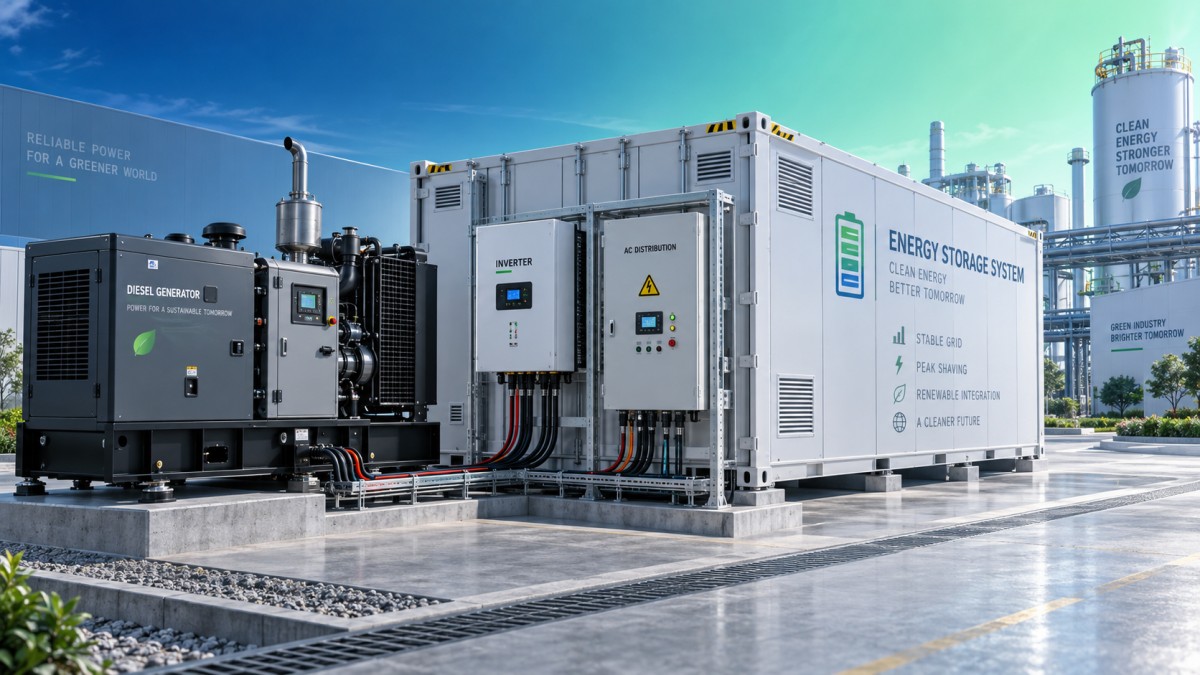
A qualified Diesel Generation And EnergyStorage Integrator should be able to translate the interval load profile into generator loading, battery state of charge, conversion losses, and dispatch behavior over time. The model should show the periods when the battery is empty, the generator is lightly loaded, or a demand peak exceeds the proposed system’s capability. These boundary conditions are more useful than a single annual savings estimate because they reveal whether the configuration is genuinely matched to the duty.
The investment becomes compelling when the system is sized around a repeatable operating problem: prolonged low-load generator running, predictable short peaks, expensive fuel logistics, measured demand exposure, or a defined critical-load requirement. Where the load is steady, generator loading is already healthy, fuel is inexpensive, and outages have little consequence, storage may add resilience but not enough economic value to justify a hybrid purchase on cost alone.