
Evaluating Excavator Battery Pack ROI Under Heavy-Duty Construction Cycles
For a finance team, an Excavator Battery Pack is not simply an equipment component with a higher upfront price than a diesel alternative. It is a long-term operating asset whose value is shaped by how the machine works, where it works, and how reliably energy can be supplied to the jobsite. In heavy-duty construction, those details matter. A battery-electric excavator used for short, irregular shifts will produce a very different return profile from one running predictable trenching, material handling, or demolition cycles for ten hours a day.
The most useful ROI question is therefore not, “How much does the battery cost?” It is, “What does the battery-powered operating model cost us over the period we expect to own and use this machine?” That wider view includes energy consumption, charging infrastructure, idle-time losses, maintenance exposure, operator utilization, downtime risk, residual value, and the cost of meeting project-site emission or noise requirements.
For businesses approving fleet investments, a disciplined total-cost-of-ownership review can turn a broad sustainability discussion into a practical capital decision.
Start with the construction cycle, not the nameplate specification
Excavators rarely operate at a constant load. A typical heavy-duty cycle may involve high-power digging, hydraulic lifting, swinging, travel between work faces, periods of waiting for trucks, and operator breaks. The duty cycle determines how quickly usable battery energy is consumed and whether the machine can complete a shift without disrupting production.
This is why a battery pack’s nominal capacity alone is a weak basis for comparing investments. Finance reviewers should ask for operationally relevant data: expected energy use per working hour, average and peak load conditions, available usable capacity, temperature effects, charging windows, and the number of shifts planned per day. A machine that performs well on a moderate urban project may require a different charging and energy-support strategy on a remote earthworks site.
It is also important to separate “engine-on hours” from productive hydraulic hours. Diesel fleets often accumulate idling time while operators wait, warm equipment, or hold position. Electric machines can reduce some of those losses, but the financial benefit only becomes visible when the baseline fuel record includes real idle hours rather than a generic fuel-consumption estimate.
In practical terms, the operating cycle should be mapped before the purchase order is approved. Review at least four items:
- Average productive hours and peak-demand periods during each shift;
- Expected breaks, shift changes, and other realistic charging opportunities;
- Jobsite electricity availability, including voltage, connection capacity, and tariffs;
- Whether the excavator must remain mobile across large or changing work zones.
Without this map, an ROI model may look precise while resting on assumptions that do not reflect the site.
The real cost comparison: diesel fuel versus delivered electricity
Energy-cost savings are often the first expected benefit, but they should be calculated at the point of use. The relevant figure is not simply the local electricity tariff. It is the cost of delivered, usable electricity after charging losses, connection charges, temporary distribution equipment, generator fuel where applicable, and potential demand charges are considered.
For a grid-connected site with stable off-peak pricing, charging may offer a clear operating-cost advantage over diesel. The calculation becomes more complex on remote projects, in locations with weak grid access, or where several high-power assets charge at the same time. If electricity is generated on-site by a diesel genset, direct fuel savings may be narrower unless the energy system is sized and operated to avoid inefficient generator loading.
That does not mean battery operation lacks value on off-grid sites. It means the comparison needs to include the whole energy architecture. A generator running continuously at low load can consume fuel inefficiently and require frequent servicing. Battery storage can absorb generator output during more efficient operating periods, supply short-duration power peaks, and reduce unnecessary generator run hours. The resulting benefit is often a combination of fuel reduction, quieter operation, fewer service interventions, and greater flexibility in when equipment is charged.
Finance teams should request a cost-per-productive-hour estimate under at least three scenarios: grid charging, generator-supported charging, and hybrid power supply. A single average energy price is rarely sufficient for a major fleet decision.
Battery life belongs in the depreciation discussion
Battery durability is central to the financial case because replacement or major refurbishment can materially affect ownership cost. However, the analysis should not assume that a published cycle-life figure translates directly into years of service. Cycle life depends on depth of discharge, charge rate, operating temperature, load profile, and the battery management strategy.
For example, an LFP battery chemistry is widely valued in industrial applications for thermal stability and cycle durability. Yet even a robust chemistry will age differently when subjected to repeated deep discharge, high ambient temperatures, or rushed charging practices. The key financial question is whether the expected state of health at the end of the planned ownership period still supports the required work cycle.
A sound procurement review should ask suppliers to clarify:
- The warranty terms, including time, operating hours, energy throughput, and exclusions;
- The usable energy window rather than only total installed capacity;
- Expected performance in cold weather, high heat, dust, vibration, and other site conditions;
- Service access, diagnostic capability, and the process for handling a battery fault;
- Whether battery replacement, remanufacturing, or second-life value has been considered in the lifecycle plan.
It is sensible to model a conservative performance case. Rather than assuming full capacity throughout the asset life, use a declining usable-capacity curve and test whether planned charging still covers the workday in later years. This avoids a common error: approving an electric excavator because year-one operating economics are attractive, then discovering that the operational margin becomes too tight as the asset ages.
Maintenance savings are real, but they must be measured honestly
Electric excavator power systems remove or reduce several diesel-related maintenance demands: engine oil and filter changes, fuel filtration, exhaust after-treatment service, belts, certain cooling-system tasks, and many engine-driven failure points. Less routine service can lower both direct maintenance cost and the hidden cost of lost machine availability.
Still, an excavator remains a heavy-duty machine. Tracks, pins, bushings, hydraulic components, attachments, structural wear, and operator-related damage do not disappear because the powertrain is electrified. Nor should finance models treat electrical diagnostics, cooling circuits, high-voltage safety procedures, or specialist technician support as cost-free.
The most credible method is to separate maintenance into two categories: costs that genuinely change with the power source and costs that remain linked to the excavator’s mechanical work. Use historical maintenance records from comparable machine classes where available. If records are incomplete, build a range rather than presenting a single optimistic number.
Downtime deserves its own line in the analysis. On a tight construction schedule, a machine waiting for a technician, fuel delivery, or charging access can affect trucks, crews, and downstream trades. The financial impact may exceed the cost of the repair itself. Conversely, scheduled opportunity charging can be manageable when it coincides with normal breaks or low-production periods. The difference lies in site planning.
Charging infrastructure can decide the investment outcome
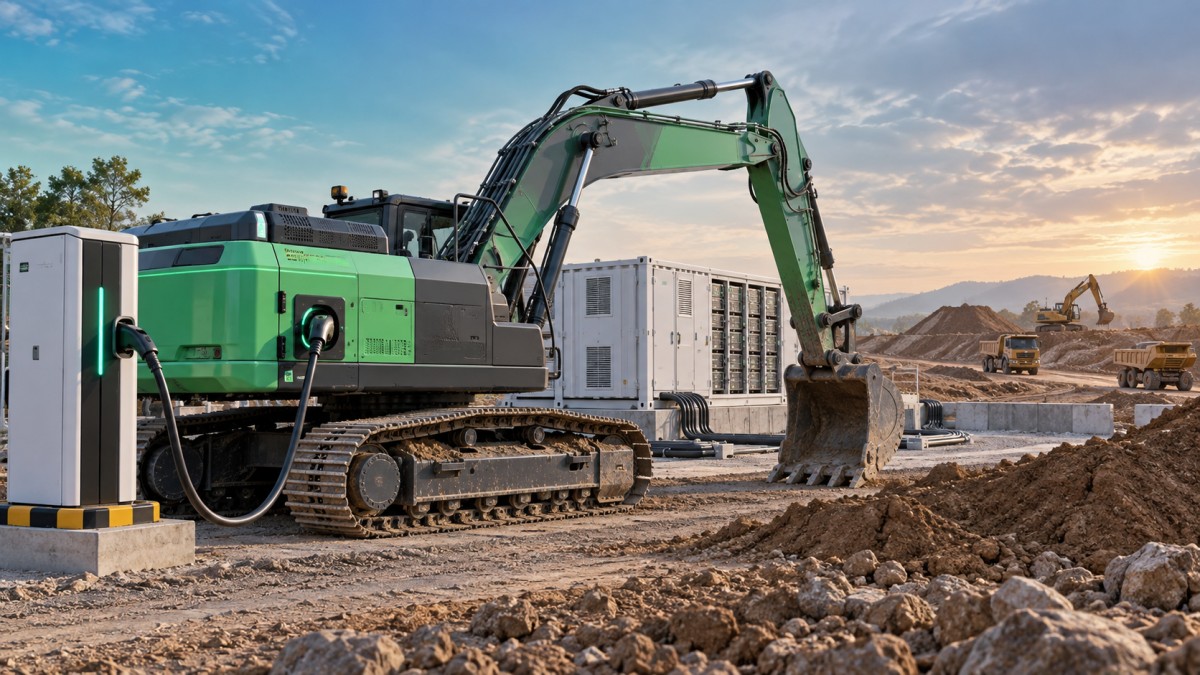
An Excavator Battery Pack delivers the strongest financial value when its charging plan fits the project rather than being added after the machine arrives. A depot-based fleet may benefit from overnight charging and predictable utilization. A project with rotating shifts may need fast charging, battery-buffered power, or a mix of stationary and mobile energy assets.
Capital expenditure for chargers, cabling, distribution upgrades, civil works, permitting, and temporary power should be included in the initial investment. These costs should then be allocated realistically. If one charging installation serves several machines over multiple projects, charging infrastructure should not be charged entirely against a single excavator. If it is purpose-built for a one-off contract, the model should reflect that limited reuse.
Hybrid site power can be particularly relevant where grid supply is unavailable or unreliable. A containerized solution combining a diesel generator, battery storage, and solar-ready inverter capacity can help smooth demand and reduce generator dependency. EN New Power Technology (Shandong) Co., Ltd., which develops new-energy power systems for off-road machinery and energy-storage applications, offers a Diesel Generation and Energy Storage integrator designed around this type of jobsite energy challenge.
Its stated configuration includes 200 kVA rated output and LFP battery storage options from 400 kWh to 1,000 kWh, with expandable capacity. Those specifications do not automatically establish project ROI; actual value depends on excavator load, number of charging assets, generator operating profile, and site schedule. But they illustrate the type of supporting infrastructure that should be evaluated alongside the machine itself, especially for remote construction environments.
Build the business case around cash flow, not broad claims
Finance approval is stronger when the model presents transparent annual cash flows instead of a simple “electric versus diesel” label. The initial investment should include the excavator price premium, battery-related options, chargers, grid connection or hybrid power equipment, installation, training, and contingency. Annual operating costs should include energy, routine maintenance, insurance implications, planned service, and any site-power rental or fuel costs.
Benefits may include avoided diesel purchases, reduced maintenance, reduced idle losses, lower emissions-related compliance exposure, access to low-noise working hours, and tender advantages where clients specify low-emission equipment. Some benefits are easy to quantify. Others are strategic and should be recorded separately rather than artificially converted into a guaranteed saving.
A useful model normally includes:
Use sensitivity analysis to expose the weak points
The best ROI model is not the one with the most favorable base-case result. It is the one that shows management what can change and when the decision stops working. Sensitivity analysis is especially important for heavy-duty electrification because utilization, energy supply, and project duration can shift quickly.
Test the effect of lower annual hours, a higher electricity rate, lower diesel prices, reduced battery capacity over time, infrastructure delays, and an additional shift. If the investment only works under ideal assumptions, it may not suit a variable construction portfolio. If it remains acceptable across a reasonable range of conditions, the business case is more resilient.
Payback period is useful for communicating the decision, but it should not be the only metric. Net present value, internal rate of return, and total cost per productive hour can reveal different aspects of the investment. A longer-payback asset may still be preferable when it reduces operating volatility, enables access to restricted urban sites, or supports a company-wide transition plan with reusable charging infrastructure.
Questions to settle before approving an Excavator Battery Pack
Before signing, finance leaders should be able to answer a few practical questions clearly. Can the machine complete its required work cycle with a reasonable operating reserve? Is power available where and when charging is needed? Who owns and maintains the energy infrastructure? What happens if a charger, battery, or site connection fails? Which savings are evidenced by site data, and which remain assumptions? Finally, does the procurement structure preserve flexibility if project mix or equipment utilization changes?
The financial case for electrified excavation is strongest when it is built around actual workload and energy logistics, not broad claims about technology. In the right operating environment, an Excavator Battery Pack can reduce fuel exposure, simplify selected maintenance activities, and support lower-emission construction operations. In the wrong environment, inadequate charging access or overstated utilization can quickly consume those advantages.
That is why careful ROI evaluation should be treated as an operational planning exercise as much as a capital-budgeting exercise. The battery is one part of the equation. The full return comes from matching the machine, the jobsite power plan, and the construction cycle with enough discipline to make the numbers hold up after the first shift, the first season, and the full ownership period.