
Industrial Battery Pack Specifications That Matter for High-Duty Equipment
Industrial Battery Pack Specifications That Matter for High-Duty Equipment
Selecting an Industrial Battery Pack for high-duty equipment is a procurement decision with direct consequences for uptime, operating cost, safety, and long-term fleet reliability.
For off-road machinery, special vehicles, and industrial equipment, nominal capacity alone is not a reliable purchasing benchmark. The most suitable pack must perform predictably under sustained load.
Procurement teams should evaluate electrical output, thermal behavior, mechanical protection, controls integration, warranty terms, serviceability, and supplier manufacturing capability as one connected specification package.
Start With the Equipment Duty Cycle, Not the Battery Nameplate
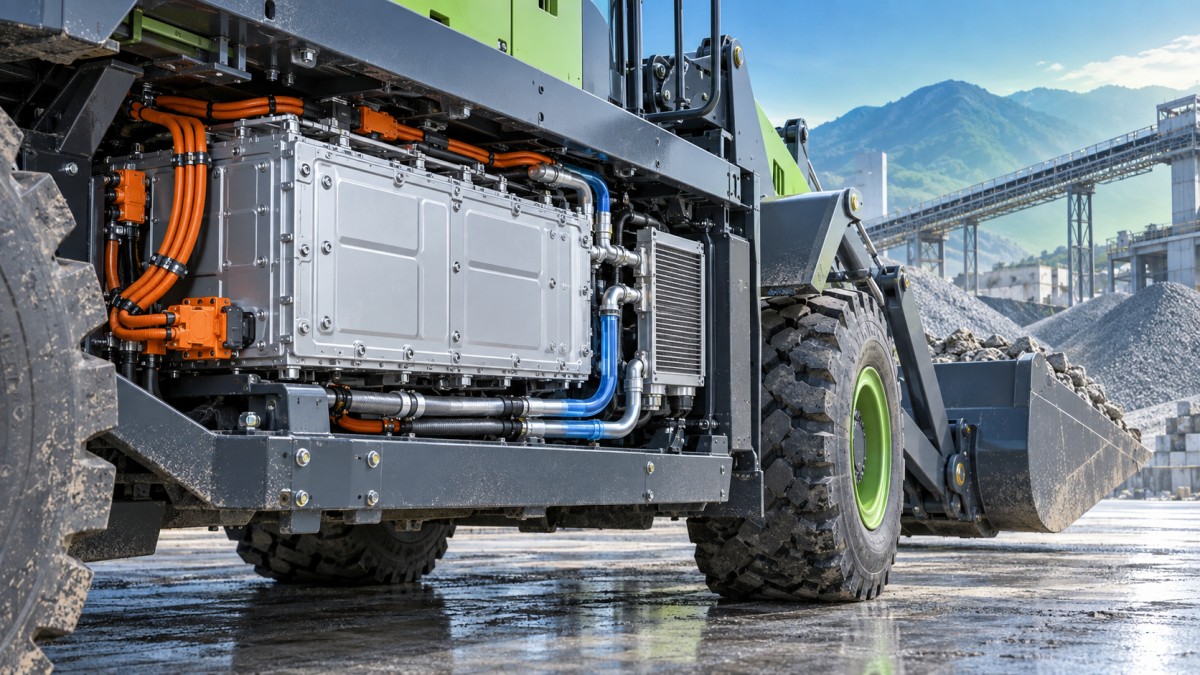
The first question is not how many kilowatt-hours a battery stores. It is whether the Industrial Battery Pack can support the equipment’s actual duty cycle.
High-duty equipment often experiences repeated acceleration, hydraulic lifting, pumping, climbing, idling, auxiliary loads, and rapid changes in environmental temperature during a working shift.
A battery pack that performs well in a laboratory range test may still be unsuitable for machines requiring continuous high current or repeated peak-power events.
Procurement specifications should therefore begin with a measured load profile from the equipment manufacturer or fleet operator, preferably covering an entire representative work cycle.
Record average power demand, maximum peak demand, peak duration, regenerative charging behavior, operating hours, idle time, charging windows, and expected ambient temperature conditions.
This information allows buyers to distinguish between energy sizing and power sizing. Both are essential, but they solve different operating risks for industrial machinery.
Energy sizing determines whether the pack can complete the required shift. Power sizing determines whether it can deliver sufficient current without unacceptable voltage drop.
When sourcing an Industrial Battery Pack, ask suppliers to confirm performance against the stated duty cycle rather than offering a generic capacity-based recommendation.
For procurement teams, this creates an auditable comparison process. Suppliers should show assumptions, test conditions, current limits, temperature ranges, and remaining capacity at shift completion.
It also prevents overbuying. Excess capacity may add unnecessary mass, cost, and charging time while failing to address the more critical requirement for sustained power delivery.
Evaluate Voltage Stability and Continuous Discharge Capability
Voltage stability is often the difference between a machine that feels consistently productive and one that slows, faults, or limits output before the battery is empty.
Nominal voltage should match the electrical architecture, but procurement teams also need to understand the pack’s operating voltage window under loaded conditions.
As battery state of charge decreases, voltage naturally falls. Under heavy current demand, internal resistance creates additional voltage sag that can affect motors, controllers, and pumps.
Ask for discharge curves at realistic current levels, including both continuous discharge and short-duration peak discharge. Curves should identify ambient temperature and battery state of charge.
Continuous current rating deserves more attention than a headline peak-current figure. A brief peak rating may look impressive but provide little value during prolonged hydraulic or traction demand.
Verify whether the stated current is available across the usable state-of-charge range or only when the pack is fully charged and thermally stable.
Also confirm how the battery management system limits output near low charge, high temperature, low temperature, or high cell imbalance conditions.
These protective limits are necessary, yet poorly matched limits can reduce equipment performance at exactly the time operators require sustained output.
For heavy equipment, compare usable power at 20%, 50%, and 80% state of charge. This provides a more realistic view of end-of-shift performance.
Buyers should request pack-level data rather than cell-level claims. Pack busbars, contactors, fuses, connectors, and cooling arrangements all influence actual delivered power.
Compare Usable Energy, Cycle Life, and Total Cost Per Working Hour
Battery capacity is commonly stated in kilowatt-hours, but procurement decisions should focus on usable energy delivered during the required equipment operating window.
A 100 kWh pack does not necessarily provide 100 kWh for daily work. Manufacturers may reserve capacity at the upper and lower limits.
Those reserves can protect battery life and safety, but they need to be transparent. Ask suppliers to specify gross capacity, usable capacity, and recommended operating window.
Cycle life should be interpreted carefully. A cycle-life figure is meaningful only when the test depth of discharge, charge rate, discharge rate, and temperature are disclosed.
For example, a battery tested at moderate discharge and controlled room temperature may show more cycles than one operating daily on rough terrain in summer.
Request an expected retention curve, not only a single cycle number. Procurement teams need to know projected capacity retention at annual operating milestones.
Warranty terms should clearly define the end-of-life threshold, such as 70% or 80% remaining capacity, and the measurement method used for warranty assessment.
Calculate total cost per productive working hour by combining pack purchase price, charging energy, maintenance needs, replacement risk, expected downtime, and residual value.
A lower-priced Industrial Battery Pack can become more expensive if it requires early replacement, causes frequent thermal derating, or reduces usable machine hours per shift.
For fleets with predictable daily operation, compare several pack options against the same annual utilization model. This gives decision-makers a defensible lifecycle-cost basis.
Confirm Thermal Management for Real Worksite Conditions
Thermal performance is a procurement priority because temperature affects available power, charging speed, energy efficiency, safety margins, and battery aging rates.
High-duty machines generate heat through sustained current draw, while outdoor equipment may face direct sunlight, dust, winter starts, rain, and limited airflow.
Ask whether the pack uses passive cooling, forced-air cooling, liquid cooling, or an integrated heating system. Each approach should match the application profile.
Passive systems may suit lower-load applications, but high-power equipment can require active cooling to prevent temperature-driven output restrictions during continuous work.
Cold-weather operation deserves equal attention. Low cell temperature can reduce discharge capability and severely limit charging acceptance without controlled battery heating.
Confirm the permitted charging temperature range and whether the battery management system automatically prevents unsafe charging below the approved cell temperature threshold.
Suppliers should provide thermal test evidence covering maximum discharge, maximum charge, high ambient temperature, low ambient temperature, and abnormal ventilation conditions.
Evaluate sensor placement as well. A single sensor may not reveal localized hot spots in large packs containing multiple modules, bus connections, and power electronics.
For equipment operating in demanding environments, clarify the cooling system’s maintenance requirements, coolant specifications, filter needs, and fault-detection functions before purchase approval.
Thermal management should be considered part of operational availability. A pack that protects itself by frequent derating may be safe, yet still unsuitable for the application.
Check Environmental Protection, Mechanical Design, and Safety Architecture
Industrial equipment operates in conditions that are more severe than typical road use. Water, dust, vibration, shocks, chemicals, mud, salt, and debris can shorten battery life.
Review the enclosure’s ingress protection rating in relation to the actual exposure level. An IP rating should be supported by test scope, not treated as marketing shorthand.
For example, a machine exposed to washdown or heavy rain needs confidence in water resistance, while quarry and construction environments require strong dust protection.
Mechanical durability includes enclosure material, mounting points, internal module restraint, vibration resistance, shock resistance, cable routing, and connector retention under movement.
Ask which standards or test methods were used for vibration and shock validation. Equipment mounted on uneven ground needs more than static structural strength.
Safety architecture should include appropriately rated fuses, contactors, pre-charge circuits, insulation monitoring where required, emergency disconnect capability, and controlled fault handling.
The battery management system should monitor cell voltage, pack current, temperature, insulation status, contactor condition, and other application-specific safety signals.
Buyers should determine whether fault codes are accessible to equipment technicians. Service teams need actionable diagnostics, not only a general warning indication.
For special vehicle applications, battery location can affect center of gravity, maintenance access, cable length, collision exposure, and vehicle payload allocation.
In a Water sprinkler application, procurement teams should assess battery sealing, vibration resistance, auxiliary pump load, and wet-environment service access together.
Ensure BMS Communication and Charger Compatibility Before Ordering
A technically capable battery can still create commissioning delays if its communication protocol does not align with the vehicle controller, charger, display, or telematics platform.
Confirm whether CAN communication is required and obtain the relevant communication matrix early. This should identify signals, message rates, identifiers, scaling, and fault states.
Important data commonly includes state of charge, state of health, voltage, current limits, temperature, alarms, charge permissions, discharge permissions, and contactor status.
Procurement documents should state who owns integration responsibility. Ambiguity between battery supplier, charger supplier, and equipment manufacturer frequently causes avoidable delays.
Charging compatibility must cover voltage range, current range, connector type, communication handshake, charging profile, and behavior during battery heating or thermal restrictions.
Ask whether the supplier supports opportunity charging, overnight charging, mobile charging, or high-rate charging, depending on the equipment’s operating schedule.
Fast charging may improve utilization, but it can accelerate degradation or require more demanding infrastructure. The charging strategy should be evaluated with lifecycle cost in mind.
Remote monitoring capability can add value for fleet operators. It can help identify abnormal temperature trends, charge misuse, recurring faults, and declining capacity before failures occur.
However, telematics should not be accepted as a vague feature. Clarify data ownership, connectivity requirements, cybersecurity measures, portal access, and ongoing software support.
Compatibility testing should be part of the supplier acceptance process. A bench test followed by an equipment-level trial reduces the risk of field integration problems.
Use a Procurement Scorecard Instead of Comparing Price and Capacity Alone
A structured scorecard helps purchasing teams compare suppliers consistently and prevents a low initial quotation from dominating a technically complex decision.
Weight the criteria according to machine criticality. For high-duty equipment, power delivery, thermal performance, reliability, and support capability may outweigh modest price differences.
Core comparison categories should include usable energy, continuous power, peak power, voltage range, thermal system, ingress protection, cycle-life assumptions, warranty, and service response.
Add manufacturing factors such as traceability, quality-control procedures, cell sourcing, pack testing, production capacity, lead time, and change-management processes.
Supplier capability matters because battery packs are integrated systems. Strong cell specifications cannot compensate for weak assembly quality, inadequate validation, or limited engineering support.
EN New Power Technology integrates research, manufacturing, and sales for new energy power systems, supporting off-road machinery and smart-grid energy storage requirements across the value chain.
When evaluating any supplier, request evidence rather than relying on brochure language. Useful evidence includes test reports, sample inspection records, quality certifications, field references, and warranty documentation.
Define acceptance criteria before issuing a purchase order. Include electrical tests, insulation tests, communication validation, charging verification, mechanical inspection, and documentation review.
It is also practical to establish a pilot order for a representative machine or small fleet. Field data can verify assumptions before broader deployment.
A clear scorecard makes internal approval easier. Engineering, operations, finance, and purchasing can see the trade-offs and agree on what value means for the fleet.
Make the Final Selection Around Availability, Not Just Specification Compliance
The best Industrial Battery Pack is not simply the one with the highest capacity or lowest quoted price. It is the one that sustains productive equipment operation.
For procurement teams, the final decision should show that the battery meets required power, shift duration, environmental exposure, integration needs, and lifecycle economics.
Prioritize verified pack-level performance under realistic duty cycles, especially where equipment faces repeated high loads, difficult terrain, wide temperatures, and limited charging windows.
Require transparent test conditions, clearly defined warranty thresholds, documented communication support, and practical service arrangements before finalizing a supply agreement.
With this approach, battery procurement becomes a reliability and productivity decision rather than a narrow component purchase based on capacity and price alone.