How Scissor Lift Battery Capacity Affects Uptime on Indoor Job Sites
How Scissor Lift Battery Capacity Affects Uptime on Indoor Job Sites
Indoor scissor lifts are often selected because they are quiet, compact, and free from tailpipe emissions at the point of use. Yet the productivity advantage can disappear quickly when a lift is parked for charging in the middle of a shift. For facility managers, rental fleet operators, contractors, and procurement teams, battery capacity is not simply a number on a specification sheet. It determines whether a platform can complete its planned work cycle, whether operators can stay on schedule, and whether charging infrastructure becomes a bottleneck.
The right Scissor Lift Battery must support more than travel time. It has to accommodate repeated lifting, platform positioning, steering, safety-system loads, payload variation, temperature conditions, and the way the site actually schedules breaks and charging windows. A battery that appears sufficient under light-duty assumptions may produce avoidable downtime in a warehouse with frequent elevation changes, a retail renovation with long operating hours, or a manufacturing site where equipment access is tightly timed.
Capacity matters, but it should never be evaluated in isolation. Usable energy, discharge behavior, charging speed, battery-management logic, lift efficiency, and maintenance discipline all shape the number of productive hours available between charges.
Capacity Sets the Operating Window, Not Just the Runtime Claim
Battery capacity is generally expressed in ampere-hours (Ah) or, more meaningfully for energy planning, kilowatt-hours (kWh). Ampere-hours alone do not tell the full story because battery voltage differs between systems. Two packs with the same Ah rating can store different amounts of energy if their voltage is different. For job-site planning, the practical question is: how much usable energy can the lift provide before it reaches the manufacturer’s recommended discharge limit?
That distinction is important. A nominal battery capacity is not always fully available in normal operation. Battery protection settings may restrict deep discharge to preserve service life and avoid voltage instability. Capacity can also be affected by temperature, age, charging history, and the instantaneous power demand created when a loaded platform rises. Decision-makers should therefore avoid treating a published capacity figure as an unconditional number of operating hours.
On indoor jobs, travel distance is often limited, but lifting frequency can be high. A maintenance team replacing lighting across a distribution center may make dozens of short moves and elevations. A contractor installing ceiling services may spend long periods elevated, then repeatedly reposition to the next work bay. In these conditions, the duty cycle is more useful than a generic “all-day” claim. It describes how the lift is actually used: travel, lift, descent, pause, accessory loads, payload, and idle time.
A larger energy reserve gives the operation more room to absorb variation. That may include an unexpectedly heavy materials load, a delayed lunch break, an extra shift, or a charger temporarily unavailable because another machine is connected. The value is not merely longer runtime; it is a lower chance that a critical task stops before a safe and convenient charging opportunity.
Why Indoor Uptime Can Be Harder to Predict Than Expected
Indoor environments remove some variables found outdoors, such as rough terrain and extreme weather, but they introduce others. Smooth floors can reduce rolling resistance, while narrow aisles, frequent stops, and dense work zones increase the number of start-stop movements. The lift may also be operated around pedestrian traffic or production lines, which means it cannot always travel or charge at the time an operator prefers.
Payload is one of the most common planning gaps. Platform capacity should not be confused with typical operating load. Tools, cable trays, ductwork, replacement parts, and two-person crews all change the energy needed for lifting. The effect is especially noticeable when work requires repeated elevation near the lift’s maximum working height. A battery selection based on an empty or lightly loaded machine can be misleading for the real task.
Another factor is auxiliary consumption. Platform controls, alarms, lights, telematics devices, and other electrical loads may consume relatively little energy individually, but their effect becomes more visible during long idle periods. In a facility where a machine remains powered while awaiting access clearance or while materials are staged, battery energy is being used even when the platform is not moving.
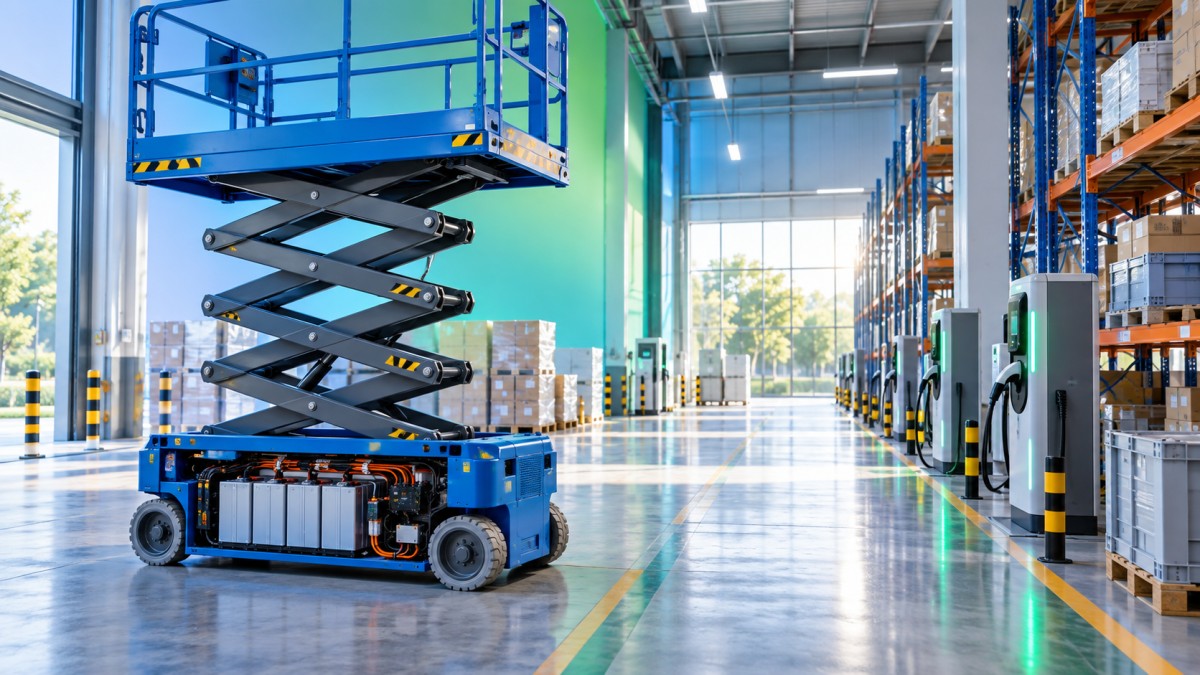
The operational consequence is straightforward: an indoor lift fleet should be sized for the most demanding normal shift pattern, not the average day on paper. If a site regularly works close to the available energy limit, minor changes in load or workflow can turn into unplanned downtime.
Matching Battery Capacity to the Duty Cycle
A useful evaluation begins with the work itself rather than the battery catalogue. Record the shift length, expected number of lift cycles, travel pattern, typical payload, maximum payload periods, and charging opportunities. If the lift is shared by multiple crews, include handover time and the possibility that the machine will not return to its original charging point.
The aim is not to buy the largest battery by default. Excess capacity can add cost, mass, charging requirements, and potentially unnecessary complexity. The better choice is a battery system with a realistic reserve after the expected shift workload. That reserve should cover normal variation without encouraging routinely deep discharge.
For fleet owners, it can be helpful to separate “minimum operational capacity” from “preferred operational capacity.” The minimum is the energy required to complete the expected cycle under ordinary conditions. The preferred level includes an allowance for delayed charging, higher-than-usual loads, or a less efficient operating pattern. This approach makes capital decisions clearer because it connects energy capacity to the cost of a missed work window rather than to a nominal runtime claim.
Charging Efficiency Is Part of the Uptime Equation
A high-capacity battery does not automatically improve availability if it cannot be recharged within the site’s working rhythm. Charging strategy must be considered at the same time as capacity. In some operations, overnight charging is enough because lifts work a single predictable shift. In others, the business case depends on recovering meaningful energy during breaks, shift changes, or planned idle periods.
Charging performance depends on the battery chemistry, charger output, temperature, state of charge, and control system. It also depends on whether the building electrical system can support simultaneous charging of several machines. A site may have enough chargers physically installed but still need an assessment of load management, circuit capacity, and charging sequence. Ignoring this can replace lift downtime with electrical infrastructure constraints.
A connected energy-management approach can make this more manageable, particularly where many mobile machines compete for limited charging capacity. Rather than treating every charger as an isolated device, an EMS can support a broader view of charging demand, energy priorities, and available site power. The appropriate configuration will depend on the facility’s electrical design and operating schedule, but the principle is useful: uptime is influenced by how energy is scheduled, not only by how much energy sits in each lift.
Power Stability Protects Both Productivity and Safe Operation
Capacity depletion is gradual, but power delivery can be a more immediate issue. As a battery’s state of charge declines, voltage behavior under load becomes increasingly relevant. A lift needs stable power when raising a platform, operating controls, and responding to safety functions. If voltage drops excessively during demand peaks, the machine may reduce performance, issue warnings, or stop operating until it is charged or inspected.
This is why battery selection should include discharge characteristics and battery management, not only total stored energy. The lift manufacturer’s electrical requirements, peak current demand, operating voltage range, connector compatibility, and protection logic must be reviewed together. Substituting a battery based only on physical fit or nominal voltage is a poor shortcut. It can create unreliable behavior and may affect service responsibilities or compliance with equipment requirements.
Maintenance also has a direct connection to power stability. Loose terminals, damaged cables, poor charging practices, and neglected battery condition checks can all reduce available performance. Lead-acid and lithium-based systems have different maintenance and charging considerations; neither should be managed with assumptions borrowed from the other. The lift and battery documentation should remain the primary reference for inspection intervals, charging procedures, storage conditions, and end-of-life handling.
Common Decisions That Create Avoidable Downtime
One common mistake is sizing from the shortest or easiest task. A lift may perform well in a brief demonstration, then struggle when deployed for a full installation shift with tools and materials on the platform. Another is assuming that every idle period is a usable charging period. In reality, chargers may be distant, access may be blocked, or operators may have no practical time to reposition equipment.
Organizations also sometimes focus exclusively on purchase price. Lower initial battery cost can be attractive, but it should be weighed against service intervals, energy efficiency, expected use pattern, charger requirements, replacement planning, and the operational impact of machine unavailability. The right financial comparison is usually cost across the operating cycle, not only the price of the battery pack.
Finally, battery and charger choices should not be made separately from fleet planning. If several lifts are added to an indoor facility, their aggregate charging behavior can affect both equipment availability and building power demand. Planning the fleet as a system is often more effective than solving each machine’s energy problem individually.
A More Practical Selection Process
Before approving a Scissor Lift Battery solution, decision-makers should request a duty-cycle review that reflects the intended lift model and site conditions. Confirm the anticipated work duration, lift frequency, average and peak payload, charging windows, ambient conditions, electrical supply, and any requirement for multi-shift use. Then verify the selected battery system against the original equipment manufacturer’s technical requirements rather than relying on broad compatibility statements.
EN New Power Technology (Shandong) Co., Ltd., established in 2020 as a wholly-owned subsidiary of a listed company, works across new energy power systems for off-road machinery and smart grid energy storage. Its R&D, manufacturing, and sales integration reflects an important consideration for equipment operators: battery performance is shaped by the complete energy system, including controls, charging behavior, production consistency, and after-sales technical coordination.
For an indoor lift operation, the most reliable capacity decision is rarely the smallest acceptable option or the largest available pack. It is the one that supports the real duty cycle with a credible energy reserve, can be charged within the actual work schedule, and delivers stable power through the shift. Those three conditions turn battery capacity from a specification into productive uptime.