
Choosing a Boom Lift Battery for Long Runtime and Outdoor Temperature Swings
A boom lift that performs well indoors can lose usable runtime quickly when it moves to an exposed façade, a cold morning maintenance route, or a hot paved work area. The problem is rarely solved by choosing the largest battery listed in a catalog. For long shifts and outdoor temperature swings, the right Boom Lift Battery must be matched to the lift’s duty cycle, current peaks, charger arrangement, battery-management capability, enclosure conditions, and the site’s real temperature range.
The practical buying rule is to start with the equipment’s energy demand rather than nominal battery capacity. Select a battery system that can deliver the required usable energy at the lowest expected operating temperature, support repeated lift and drive loads without excessive voltage sag, and accept charging within the available downtime. A system that looks adequate at room temperature may be undersized when cold weather, slope travel, platform loading, or repeated elevation cycles are added.
Begin with the work pattern, not the battery label
Procurement decisions often begin with voltage and amp-hour ratings because they are easy to compare. Those figures matter, but they do not describe the whole operating window. A boom lift draws power differently while driving, elevating, slewing, extending, holding position, and operating auxiliary equipment. A battery that has enough stored energy for a light-duty indoor shift may not maintain stable performance during a mixed outdoor schedule.
Before comparing battery options, obtain a realistic description of how the lift will be used. The most useful inputs are not generic daily hours but the work events that consume energy:
- Expected operating hours between charging opportunities.
- Number and duration of drive movements, especially on uneven or inclined surfaces.
- Frequency of boom elevation, extension, rotation, and repositioning.
- Typical platform load and use of electrically powered accessories.
- Lowest and highest ambient temperatures at the actual work location.
- Whether the lift remains outdoors overnight or is stored and charged under cover.
- Available electrical supply, charging window, and restrictions on daytime charging.
These details expose a common mismatch: a battery may be specified for average energy consumption while the application includes repeated high-current events. High current demand can reduce available capacity, increase heat generation, and trigger low-voltage protection earlier than expected. The result may be a lift that still has some energy remaining but cannot complete a demanding movement reliably.
Translate runtime expectations into usable energy
Nameplate capacity is not the same as usable capacity. The usable portion depends on the battery chemistry, discharge rate, temperature, voltage limits set by the machine, and the depth of discharge permitted for routine operation. Procurement teams should ask suppliers to clarify the usable energy range under expected load and temperature conditions instead of relying only on nominal amp-hour values.
For a battery pack, energy is commonly expressed in watt-hours or kilowatt-hours. A simple first estimate is nominal voltage multiplied by nominal amp-hours. That estimate should then be treated as a starting point, not a runtime guarantee. A more decision-ready calculation considers the lift’s energy use per shift, a reserve for unexpected movements or delayed charging, and a reduction factor for adverse temperature conditions.
For example, the sizing discussion should distinguish between a lift operating continuously at moderate load and one that spends long periods stationary but performs short, demanding movements. The first case may be driven mainly by total energy. The second may require attention to both energy capacity and peak discharge capability. A battery pack must meet both conditions.
Do not size to the ideal shift
A battery selected for a planned eight-hour schedule can become a problem when a job runs longer, weather delays charging, or the lift must travel farther than planned. A sensible specification includes an operational reserve. The reserve is not wasted capacity; it protects uptime when real work differs from the planned cycle.
Reserve requirements should be greater where the equipment cannot be easily returned to a charging location, where elevated work creates interruption costs, or where cold conditions are expected. It is also useful to separate “finish the normal shift” from “reach a safe charging location.” The battery should support the latter even when the remaining-energy indication is conservative or operating conditions have changed.
Outdoor temperature changes affect more than runtime
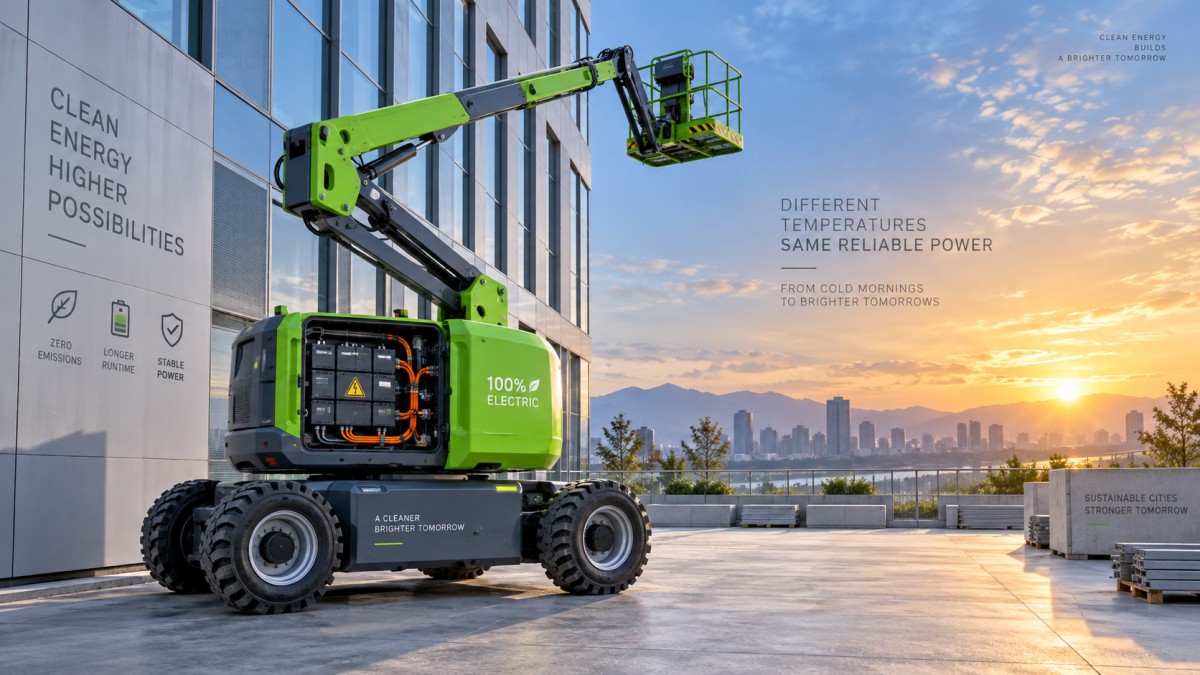
Temperature influences available energy, internal resistance, charging acceptance, and battery life. Cold conditions generally reduce the speed of electrochemical reactions and increase resistance. In practical terms, the battery may deliver less usable energy and show a larger voltage drop during demanding movements. A lift operating acceptably in mild weather can reach low-voltage thresholds earlier in cold conditions, particularly when the battery starts the day at a low state of charge.
Heat creates a different concern. High ambient temperature, direct sun exposure, high current draw, and charging can combine to raise battery temperature. Excess heat can accelerate degradation and may cause protective controls to limit charging or discharge. The right selection therefore involves the full temperature profile: overnight minimum, daytime maximum, heat from the work surface, solar exposure, and temperature inside the battery compartment.
Ask whether the proposed battery system has defined operating and charging temperature limits, and how it behaves outside its preferred range. For outdoor fleets, this should include practical questions such as whether charging is restricted below a given battery temperature, whether the pack supports controlled warming where required, and whether cooling or thermal derating is used in high-temperature operation.
Storage conditions can undermine an otherwise correct choice
A battery may be technically suitable for outdoor use yet still perform poorly if the equipment is left inactive in freezing conditions with a low state of charge. Likewise, charging immediately after a hot afternoon shift can be different from charging after the battery has cooled. Procurement specifications should include storage and charging conditions, not only operating conditions.
Where lifts work across seasons, require suppliers to state the process for low-temperature charging, high-temperature protection, and state-of-charge management during extended idle periods. These requirements should be compatible with the site’s operating routines. A feature that depends on heated storage, for instance, will not solve a problem at a location without sheltered overnight parking.
Compare battery chemistries by operating constraints
Lead-acid and lithium-based systems are often evaluated for boom lifts, but the appropriate choice depends on the job pattern and support conditions rather than a broad claim that one chemistry is always better. Lead-acid batteries may suit operations with predictable schedules, adequate charging time, and established maintenance practices. Their usable capacity and charging behavior should be evaluated carefully when deep cycling, partial charging, or cold weather are expected.
Lithium-based battery systems can offer high usable energy, efficient charging, and lower routine maintenance requirements, but they require coordinated protection, cell balancing, thermal control, and communication with the equipment where applicable. Battery management quality is therefore part of the purchasing decision, not a secondary technical detail.
Examine the battery management and machine interface
A modern battery pack is not only a collection of cells. Its battery management system monitors cell voltage, current, temperature, state of charge, and fault conditions. For boom-lift use, buyers should understand how that system interacts with the vehicle controller, onboard charger, display, and service tools.
Important questions include whether the state-of-charge signal is reliable during variable load, whether the machine receives warnings before a protective shutdown, and whether fault information can distinguish a battery limitation from a charger or vehicle issue. A display that reports a percentage without context is less useful than a system that can identify low-temperature charge restriction, over-temperature protection, communication errors, or imbalance warnings.
Energy monitoring can also help fleet operators identify runtime loss before it becomes a missed shift. An EMS used for energy management can support visibility into charging status and energy use where the overall equipment or fleet architecture is designed to use that information. The value is not in adding another screen; it is in identifying whether short runtime is caused by operating intensity, incomplete charging, temperature limits, or battery condition.
Check charging infrastructure before selecting fast charging
Fast charging is attractive when lifts have limited downtime, but it should not be chosen in isolation. The charger, site electrical supply, battery acceptance rate, thermal limits, and operating schedule must work together. A faster charger does not guarantee faster turnaround if the battery temperature is outside its allowed charging range or if site power is shared with other loads.
Clarify whether charging will occur overnight, during meal breaks, between work zones, or whenever equipment is idle. Partial charging may be operationally useful for some battery systems, but the supplier should define its effect on runtime expectations and long-term battery operation. For lead-acid installations, incomplete charge cycles and extended operation at partial state of charge may have consequences that should be addressed in the maintenance plan.
The connector type, cable routing, weather exposure, and charger location also deserve attention. Outdoor charging points need procedures that prevent damaged cables, poor connections, water exposure, and avoidable unplugging. These are routine details, yet they often explain why a theoretically adequate battery does not begin the shift fully charged.
Make enclosure and installation part of the specification
The battery is affected by the compartment around it. Check whether the enclosure protects against moisture, debris, vibration, temperature buildup, and connector damage while still allowing required ventilation or heat transfer. A pack with robust internal controls can still be compromised by poor drainage, loose mounting, corroded terminals, or blocked cooling paths.
Weight and dimensions must also be confirmed against the boom lift manufacturer’s approved configuration. Replacing a battery with a heavier, lighter, taller, or differently balanced unit can affect installation, cable routing, machine stability assumptions, and service access. Do not treat a similar voltage rating as proof of interchangeability. The complete electrical and mechanical fit must be verified.
Questions that reveal whether a proposal is truly comparable
When two suppliers offer packs with similar voltage and nominal capacity, request answers in the same operating terms. Ask for discharge performance at expected temperature ranges, continuous and peak current capability, charging limits, protective thresholds, cycle-use assumptions, mounting requirements, and diagnostic access. A proposal that cannot explain these conditions is difficult to evaluate against real outdoor use.
- What runtime estimate applies to the specified boom-lift duty cycle, not merely to a generic load?
- At what temperatures can the battery discharge and charge normally, with limits clearly identified?
- How does the pack respond to low-temperature charging attempts?
- What reserve remains when the machine reaches its low-energy warning or reduced-performance point?
- Does the existing charger match the battery’s voltage, charging profile, communication needs, and connector arrangement?
- What diagnostic information is available to site technicians when runtime drops or charging stops?
- What inspection items are required for cables, terminals, mounting hardware, and the battery compartment?
These questions shift the discussion away from a simple purchase-price comparison. A lower-cost battery that requires frequent unplanned charging, loses performance in winter, or creates difficult fault diagnosis can raise equipment downtime and operational cost. Conversely, a higher-capacity pack is not automatically the better value if its charging requirements do not fit the available power and shift schedule.
Choose a specification that remains workable in the worst routine condition
The final selection should be based on the most demanding normal condition, not an exceptional weather event and not an ideal day. For a boom lift working outdoors, that often means assessing the shift at the lower end of the seasonal temperature range, with normal platform load, typical travel distance, and realistic charging access. Confirm that the selected battery can supply required energy and current with reserve under those conditions.
Before releasing a purchase order, align the battery supplier, lift manufacturer or authorized technical documentation, charger provider, and site team on electrical compatibility, charging procedures, temperature boundaries, and service responsibilities. That alignment prevents a familiar outcome: a battery pack that is individually capable but poorly matched to the machine, charger, or daily operating routine.