
Can Residential Energy Storage Deliver Real Energy Independence?
Can Residential Energy Storage Deliver Real Energy Independence?
Can Residential Energy Storage for Energy Independence move beyond a sustainability goal and become a practical resilience strategy? In many markets, that question is no longer theoretical. Electricity prices can change sharply, weather-related outages can disrupt operations, and household electricity demand is rising as heating, cooling, electric vehicles, and home-based work become more electrified.
For decision-makers, however, “energy independence” needs a more precise definition. A battery does not automatically disconnect a property from the grid, eliminate all energy costs, or guarantee power through a multi-day outage. What it can do is give a home, a residential development, or a distributed-energy business greater control over when electricity is purchased, stored, used, or supplied to critical loads. The difference between those outcomes is where procurement discipline matters.
The strongest projects start by treating storage as an operating asset rather than a symbolic add-on to rooftop solar. Its value may come from outage protection, self-consumption of solar generation, time-of-use tariff management, reduced generator runtime, or a combination of these functions. The right solution depends less on headline battery capacity than on the actual load profile, grid conditions, local interconnection rules, and the organization’s tolerance for downtime.
Independence Is a Spectrum, Not a Switch
The phrase energy independence is often used too broadly. A grid-connected home with solar and storage may remain dependent on the grid during long periods of poor weather, but it can still materially reduce exposure to peak pricing and brief interruptions. At the other end of the spectrum, an off-grid site needs enough generation, storage, controls, and reserve capacity to operate under less favorable conditions. Those are fundamentally different engineering and cost models.
A useful way to assess a project is to distinguish among three targets. The first is bill optimization: charging when energy is cheaper or surplus solar is available, then discharging when household demand or tariffs are higher. The second is backup resilience: maintaining selected circuits such as lighting, refrigeration, communications, security, pumps, or medical equipment during an outage. The third is autonomous operation: sustaining most or all loads over an extended period with limited or no grid support.
Confusion arises when a system sized for the first target is expected to achieve the third. A battery that performs well in daily cycling may not have sufficient usable energy for a prolonged outage. Likewise, a high-energy battery without adequate inverter power may not start or support a large heat pump, well pump, induction cooker, or EV charger. Procurement teams should ask suppliers to separate energy capacity, power output, backup duration, and controllable loads instead of presenting them as one promise.
What Actually Determines Whether Storage Delivers Value
Residential energy storage economics are not defined by battery price alone. Installed cost includes the battery, inverter or power conversion system, energy management controls, electrical protection, mounting or enclosure work, commissioning, monitoring, permits, and any changes to the property’s distribution board. In some projects, the most consequential cost is not equipment but the electrical rework needed to create a properly isolated critical-load panel.
The revenue or savings side is equally site-specific. Where retail tariffs vary significantly by time of day, storage can shift imported energy away from expensive periods. Where export compensation for solar is modest, keeping solar energy on site may be more attractive than exporting it. In weak-grid locations, avoided disruption and reduced diesel consumption can outweigh tariff arbitrage. Yet none of these value streams should be assumed without interval consumption data and an understanding of how local utility rules treat import, export, and backup operation.
Battery life also needs to be interpreted correctly. Cycle-life figures are useful, but they are not a complete forecast of asset life. Actual performance is affected by depth of discharge, temperature, charge and discharge rates, control settings, calendar aging, and how often the system remains at very high or very low state of charge. A credible commercial evaluation should clarify usable capacity at commissioning, expected operating window, warranty terms, service responsibilities, and the procedure for replacing failed components.
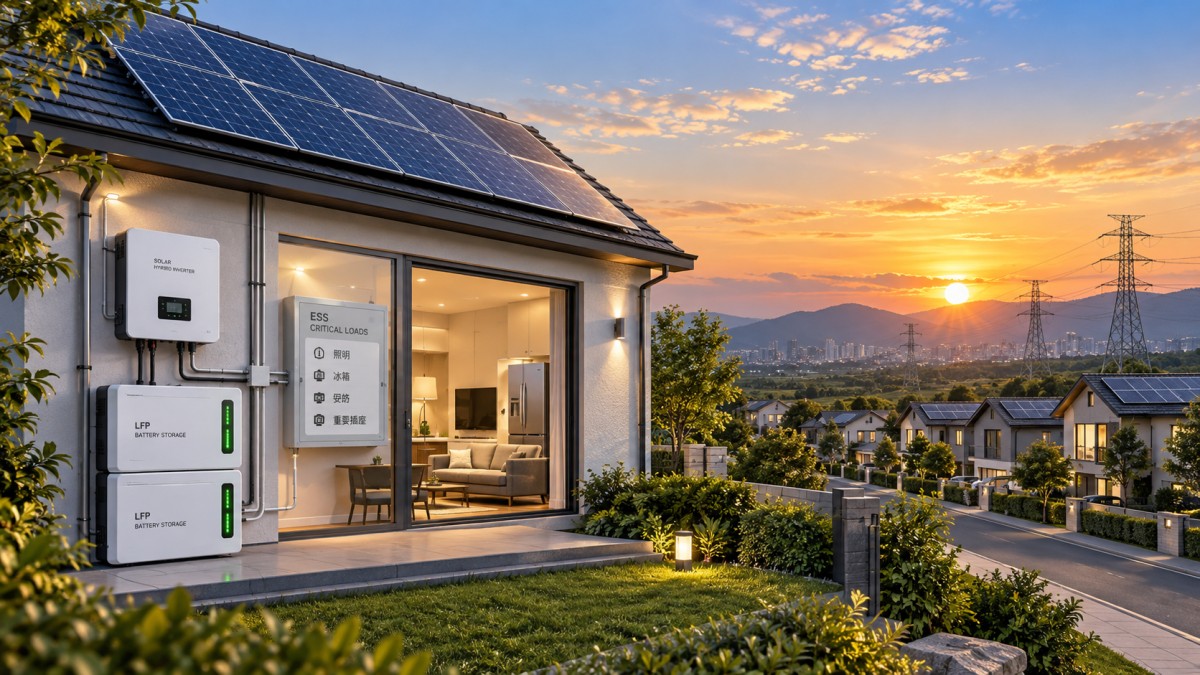
For a portfolio owner, developer, or employer supporting residential energy programs, the practical question is therefore not “How many kilowatt-hours should we buy?” It is “Which loads must remain available, what events are we designing for, and which energy flows create measurable savings?” That sequence prevents the common error of buying capacity first and discovering later that the system cannot support the intended operational strategy.
The load profile comes before the battery size
A sound sizing exercise begins with at least several representative periods of electricity data, ideally covering seasonal changes. Peak demand matters because it determines inverter and backup power requirements. Daily energy consumption matters because it shapes storage duration. Solar production matters because it determines how often the battery can be charged from on-site generation. A household with modest average consumption but one large intermittent motor load may require a very different design from a home with stable evening demand.
Critical-load planning deserves particular attention. During an outage, a system may be configured to support only selected circuits. This is often more economical and more reliable than attempting to back up every appliance. It also makes expectations clearer: a battery may preserve communications, refrigeration, lighting, and essential controls, while high-demand equipment is managed separately. For projects that require whole-home backup, the supplier should demonstrate how surge loads, phase configuration, transfer logic, and load shedding are handled.
Technology Choices That Affect Long-Term Ownership
Lithium iron phosphate, commonly called LFP, is widely considered for stationary storage because it is associated with long cycle performance and thermal stability characteristics suited to many fixed applications. But cell chemistry is only one part of the system. Battery management, thermal design, enclosure protection, inverter compatibility, fault detection, remote monitoring, and installation quality all influence the asset’s real-world performance.
Temperature is a recurring issue in procurement discussions. A system installed in a garage, utility room, coastal property, or outdoor enclosure may encounter conditions very different from the laboratory assumptions behind a sales presentation. Buyers should confirm the declared ambient operating range and ask what operating limits, derating behavior, or protective controls apply at temperature extremes. They should also verify the proposed installation location against local fire, electrical, ventilation, access, and emergency-response requirements. These rules vary by jurisdiction and should not be inferred from a product brochure.
The energy management system is another area where low initial cost can create operational friction later. Good controls should prioritize safety, maintain backup reserve when needed, coordinate solar charging, avoid unnecessary grid imports, and provide understandable system status. For multi-property deployments, visibility matters even more. Fleet operators need a practical way to monitor alarms, state of charge, communications health, and performance trends without relying on manual site visits for every issue.
A Procurement Framework That Avoids False Comparisons
Comparing bids solely on nominal kilowatt-hours is misleading. Two systems with a similar nameplate capacity can differ in usable energy, continuous output, response behavior, integration scope, service coverage, and controls. The following questions create a more useful comparison between proposals.
This approach also makes it easier to distinguish household-scale requirements from larger distributed-energy needs. A residential development, small grid, remote community facility, or mixed-use site may require a more robust storage layer than an individual home. In those cases, modular systems that can connect with photovoltaic generation, micro-wind resources, AC generators, and the grid can support a broader resilience strategy. The system should still be matched to the load and operating mode rather than selected because a larger unit appears more independent.
For example, the ENNP-MBES platform behind the 100KWh Diesel Power Generation Energy Storage System is designed for industrial and commercial use cases where mobile deployment, generator coordination, small-grid operation, and low-noise power support may be relevant. It uses LFP-280Ah cells, provides 100.352kWh nominal energy and 50/60kW PCS-rated power, with a stated response time below 20 ms. These figures are relevant to larger resilience architectures, but they should not be used as a shortcut for sizing a typical residence. The proper question remains whether the power, capacity, footprint, operating temperature range, and integration method fit the project design.
Where Residential Storage Can Fall Short
Storage is not a substitute for energy efficiency or load management. An inefficient building with unmanaged heating, cooling, or charging loads will consume stored energy quickly. Before increasing battery capacity, it can be sensible to review insulation, HVAC controls, appliance scheduling, and EV charging behavior. Reducing unnecessary demand often lowers the required storage size and improves resilience at the same time.
Another risk is assuming that solar capacity and battery capacity are automatically balanced. A large battery paired with insufficient solar may spend much of its time charging from the grid. Conversely, a solar array may produce surplus energy that cannot be stored if the battery is too small or charging power is constrained. Seasonal variation matters here: a design that appears highly self-sufficient in summer may provide far less autonomy in winter.
There is also an organizational risk in fragmented responsibility. If one party supplies the battery, another the inverter, another the solar array, and another the installation, fault resolution can become slow. For larger programs, procurement documents should define interface responsibilities, commissioning tests, documentation, remote-access ownership, training, and post-installation escalation paths. A low equipment quote may not represent the lowest operational cost when these responsibilities are unclear.
From Equipment Selection to an Operating Strategy
Real energy independence is best understood as controlled dependence: the ability to choose when grid power is used and to maintain essential services when the grid is unavailable. Residential Energy Storage for Energy Independence can support that goal when it is designed around measurable loads, realistic outage scenarios, and clear economic assumptions. It is less convincing when independence is treated as a marketing label detached from operating conditions.
EN New Power Technology (Shandong) Co., Ltd., established in 2020 as a wholly-owned subsidiary of a listed company, works across new-energy power systems for off-road machinery and smart-grid energy storage. Its integration of R&D, manufacturing, and sales across the value chain reflects an important procurement consideration: energy storage is not only a battery purchase, but an engineering, controls, service, and lifecycle-management commitment.
Before approving a project, decision-makers should request a load-based design, an explicit backup scope, a transparent bill-of-materials and installation boundary, and a lifecycle view that includes monitoring and service. If the supplier can explain what the system will not do as clearly as what it will do, the proposal is usually on firmer ground.