
What Buyers Should Evaluate Before Deploying Pure Electric Mining Trucks
A mine can lose productive hours long before a truck stops moving. A battery-electric haul unit may look suitable on a specification sheet, yet fail to meet the planned cycle time when the route has long uphill sections, loose underfoot conditions, extended queueing, or limited charging access. For procurement teams, the key question is not whether a Pure Electric Mining Truck can carry the rated payload. It is whether the truck, energy system, charging plan, and site operating pattern can work together without reducing material movement.
Before deployment, buyers should evaluate the vehicle as part of a production system. Purchase price matters, but it is only one input. The decision should be based on duty-cycle energy demand, usable range under load, payload performance, charging and electrical infrastructure, safety controls, maintenance capability, and lifecycle cost. A truck that is technically capable but poorly matched to the mine’s haul profile can create bottlenecks at chargers, force premature battery replacement, or require more units than initially budgeted.
Start with the actual haul cycle, not the advertised range
Published range figures are rarely enough for a mining purchase decision. Mining routes are not steady road cycles. Energy consumption changes with gradient, rolling resistance, road condition, ambient temperature, payload, operator behavior, auxiliary loads, and stop-start frequency. A truck operating on a short, level haul road will place very different demands on its battery than one climbing from a loading face to a crusher.
Build an operating profile from the work the truck is expected to perform. The profile should include loaded travel distance, empty return distance, vertical elevation change, expected payload, average and peak travel speeds, loading and dumping wait time, shift length, and planned breaks. Also record the periods when roads are wet, soft, rough, or congested. These conditions may not be constant, but they often determine the highest daily energy requirement.
A useful procurement review separates energy use into three questions:
- Energy per cycle: Can the battery complete a loaded trip, return journey, and normal waiting time with a sensible operating reserve?
- Energy per shift: How many cycles are required, and where will charging occur without disrupting loading, hauling, or dumping?
- Peak-condition energy: What happens when temperature changes, road rolling resistance rises, or production requires repeated high-load cycles?
Do not treat nominal battery capacity as fully available operational energy. Battery management systems maintain limits to protect cells, and usable capacity can vary with temperature, power demand, and battery condition. Ask suppliers to explain the stated capacity, usable energy window, expected power limits at low state of charge, and the assumptions used in any range calculation.
Check whether battery capacity and power are both sufficient
Capacity determines how much energy can be stored; power determines how quickly that energy can be delivered or accepted. A truck may have enough stored energy for the route but still perform poorly if the battery and drive system cannot sustain required torque on steep grades or during repeated acceleration with a full load. Conversely, a high-power system may meet peak traction demands but need frequent charging if its usable energy is too limited for the production plan.
Procurement specifications should therefore request more than a single kWh figure. Review battery chemistry, nominal and operating voltage range, continuous and peak discharge capability, thermal-management method, enclosure protection, battery-management functions, and the way the truck manages derating. Liquid cooling may be relevant where sustained heavy work, high ambient temperatures, or rapid charging create significant heat. A robust ingress-protection rating also deserves attention where the machine will be exposed to dust, washdown, standing water, or muddy service areas.
Battery systems used in heavy-duty off-road equipment often need similar scrutiny even when the machine category differs. For example, the battery configurations presented with Electric Mini Excavator Products include lithium iron phosphate chemistry, liquid cooling, and IP67 protection. Those features do not establish suitability for a mining truck by themselves, but they illustrate the type of system-level information buyers should request: chemistry, thermal control, voltage window, charging and discharge limits, and environmental protection rather than capacity alone.
Ask about derating before it becomes a production problem
Battery and power electronics may reduce available output when temperatures are too high or too low, when state of charge is low, or when protection thresholds are reached. This is not necessarily a defect; it is a control measure. The procurement issue is whether derating occurs during the mine’s expected operating window. Ask for the conditions that trigger power reduction, how the operator is informed, and whether the truck can complete a loaded climb at the lowest planned operating charge level.
Where trucks work on long descents, regenerative braking should also be evaluated as an energy and control function. Regeneration can recover energy, but its contribution depends on grade, speed, battery acceptance capability, and state of charge. A battery near its upper charge limit may accept less regenerative energy. The vehicle must still maintain safe downhill control when regeneration is restricted, so mechanical braking, retarding strategy, and thermal behavior must be assessed together.
Design charging around dispatch reality
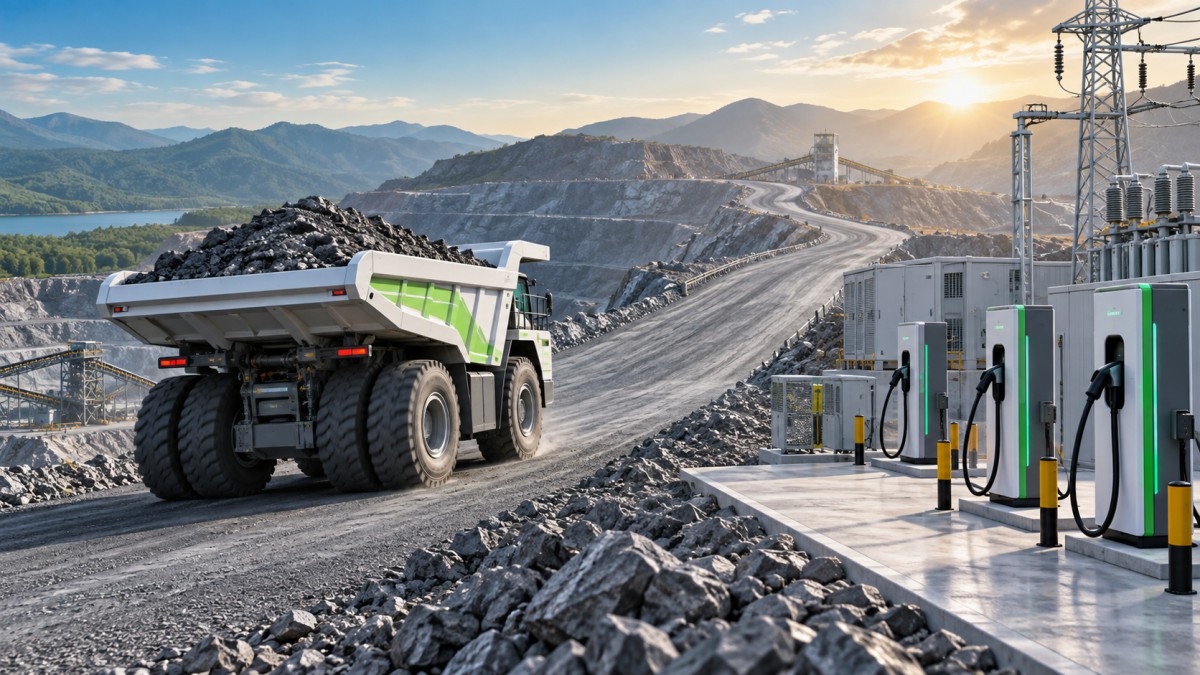
A charger that is available on paper may be unavailable in the working shift. Queueing, truck positioning, cable handling, breakdowns, grid limits, and a charging location that is too far from the route can erode the planned benefit of electric operation. Charging strategy should be modeled using the actual dispatch schedule, not only the charger’s maximum rated output.
First determine whether the operation needs depot charging between shifts, opportunity charging during breaks or loading delays, battery swapping, or a combination of methods. Each approach changes the fleet plan. Depot charging may be simpler where trucks have sufficient energy for a full shift. Opportunity charging can support intensive cycles, but only when the charge window is repeatable and the charging point does not interfere with mine traffic. Swapping can reduce waiting time, yet it introduces spare battery inventory, handling equipment, battery inspection procedures, and controlled storage requirements.
The electrical supply assessment should cover more than the charger nameplate rating. Buyers need to understand available site capacity, transformer and distribution requirements, cable routing, protection equipment, demand peaks, backup arrangements where relevant, and the installation lead time. A mine may have enough total electrical capacity but still need upgrades to supply a concentrated charging area safely and reliably.
Validate payload, traction, and chassis performance under site conditions
Electric drivetrains can provide strong low-speed torque, but buyers should not assume this automatically produces better haulage performance. Truck productivity depends on the interaction between motor output, gearing, tire selection, axle load, traction control, suspension, road condition, and payload distribution. A vehicle should be assessed at the mine’s intended gross vehicle weight and route gradient, not only in an unloaded demonstration.
Review the manufacturer’s payload definition carefully. Confirm whether it refers to nominal payload, maximum technical payload, or a payload achievable under a stated route condition. Compare body volume and material density with the operation’s actual material. Low-density material can fill the body before reaching weight limit; dense material can exceed axle or tire limits before the body appears full. The loading method also matters, because uneven loading can affect stability, tire wear, braking behavior, and suspension stress.
Road condition deserves the same discipline as truck specification. Rolling resistance from rough or soft ground raises energy use and can reduce available speed. Drainage, road camber, turning radius, ramp width, and passing arrangements influence both safety and cycle time. Before committing to a fleet, identify the worst routinely used sections of road and determine whether the truck retains sufficient gradeability, braking control, and energy reserve there.
Do not separate safety evaluation from energy evaluation
Electric mining trucks introduce high-voltage systems into an already demanding environment of heavy loads, traffic interaction, dust, vibration, water, and maintenance activity. The safety review should cover the truck, charging area, recovery procedures, and personnel readiness as one operating system.
Request clear documentation for high-voltage isolation, emergency shutdown, interlocks, insulation monitoring, fault indication, cable and connector protection, battery thermal event response, and safe recovery of a disabled vehicle. Operators need understandable warnings and defined actions for low state of charge, charging faults, reduced-power modes, and loss of propulsion. Maintenance teams need lockout and verification procedures appropriate to high-voltage equipment, not only conventional mechanical isolation practices.
Charging areas need controlled traffic flow and adequate physical protection. Consider how trucks enter, park, connect, leave, and pass through the area without exposing personnel to moving equipment or damaged cables. Environmental conditions should be reviewed as well: dust accumulation, standing water, poor drainage, and vehicle washdown can all affect charging equipment placement and maintenance needs.
Compare lifecycle cost using production assumptions that can be challenged
A low acquisition cost can be offset by additional chargers, electrical upgrades, spare batteries, route changes, fleet redundancy, and training. At the same time, comparing electricity cost with diesel cost alone can miss potential changes in maintenance work, consumables, downtime patterns, and power demand charges. The right comparison is a transparent total cost of ownership model tied to the mine’s planned output.
Build the model around equivalent work: tonnes moved, cycles completed, or productive operating hours. Include vehicle purchase, charging infrastructure, installation work, electrical distribution, energy consumption, planned maintenance, tires, brake and drivetrain service, battery warranty terms, expected downtime, replacement parts, software or diagnostic requirements, and residual-value assumptions if they are relevant to the internal approval process.
Energy price should be tested across realistic operating conditions. If charging occurs during peak demand periods, the cost structure may differ from overnight charging. If power availability limits simultaneous charging, the resulting production loss may be more significant than the electricity unit price. Sensitivity testing is useful here: change the haul distance, cycle count, road resistance, charging availability, and energy price assumptions to see which variables materially affect the decision.
Read warranty terms as operating constraints
Battery warranty language may specify retention thresholds, operating temperature limits, required service records, approved charging equipment, or permitted charging practices. These terms can influence route planning and maintenance procedures. Buyers should clarify which components are covered, how diagnostics are performed, who determines whether a failure is a battery, charger, vehicle-control, or site-power issue, and what support is available when a truck is immobilized.
Prepare the maintenance organization before delivery
Electric trucks may reduce certain engine-related service tasks, but they do not eliminate maintenance planning. Tires, suspension, steering, hydraulics where fitted, brakes, chassis structures, cooling circuits, connectors, high-voltage cabling, and charging hardware still require inspection. In mining service, dust, vibration, corrosion, and cable damage can create issues that are not visible in a clean workshop environment.
Evaluate whether the site has suitable diagnostic tools, trained technicians, safe battery-handling arrangements, spare-part access, and a practical escalation path for software or high-voltage faults. Ask which inspections are daily, weekly, and periodic; which require trained high-voltage personnel; and whether remote diagnostics depend on site connectivity. Maintenance responsibility should be written into the operating plan rather than left to be resolved after commissioning.
Use a staged acceptance process
A procurement decision is stronger when acceptance criteria are defined before the truck arrives. The criteria should reflect the intended route and payload, while allowing for normal site variation. They may cover loaded cycle completion, energy consumption recording, charging time, grade performance, braking and retarding response, temperature behavior, fault reporting, and compatibility with dispatch practices.
Begin with a site readiness review of roads, charging equipment, electrical supply, traffic controls, maintenance procedures, and operator training. Then use controlled operating trials to collect data across representative loads and route conditions. The purpose is not to chase a single best-case figure; it is to identify whether the operating margin remains acceptable when conditions become less favorable. Only after that review should fleet quantity, charger quantity, and charging schedule be finalized.
A Pure Electric Mining Truck purchase is most defensible when the selected configuration has enough energy and power margin for real mine conditions, charging fits the dispatch plan, and the site is prepared to maintain and operate the system safely. Treating the truck and infrastructure as one capital decision helps prevent a promising electric deployment from becoming a constraint on production.