
Residential Energy Storage Options Compared by Capacity, Warranty, and Expansion
Residential Energy Storage Options Compared by Capacity, Warranty, and Expansion
Selecting Residential Energy Storage is often presented as a simple battery-capacity exercise: compare kilowatt-hours, choose the largest number the budget allows, and move on. In real project evaluation, that shortcut creates expensive mismatches. A system can have ample nominal capacity yet fail to support the circuits a homeowner expects during an outage. Another may look attractive on a cost-per-kWh basis but have restrictive warranty conditions, limited inverter compatibility, or no practical path for expansion.
For business evaluators, the more useful question is not “Which battery is best?” It is “Which storage architecture fits this property, its load profile, its solar plan, and its likely future?” The right answer differs for a small urban home seeking evening solar self-consumption, a rural property requiring outage resilience, and a high-consumption residence with electric heating, EV charging, or several air-conditioning units.
Capacity, warranty, and expandability are the three most visible decision points. They are also tightly connected. Choosing a larger system may reduce daily cycling stress, but it raises capital cost. A long warranty sounds reassuring, but its value depends on throughput limits, retention terms, labor coverage, and the operating conditions required to keep it valid. Expansion is useful only when the system is genuinely designed for it—not when extra modules merely appear possible in a brochure.
Start With Usable Capacity, Not the Nameplate Figure
Battery capacity is generally expressed in kilowatt-hours (kWh), but a procurement review should separate nominal capacity from usable capacity. Nominal capacity is the total energy stored in the battery. Usable capacity is the energy the system allows the owner to access after reserving protective margins for battery health and control logic. The difference matters because backup duration calculations should be based on usable energy, not the headline number.
A useful early-stage calculation is straightforward:
Estimated backup duration = usable battery capacity ÷ average backed-up load.
The hard part is defining the backed-up load honestly. A home may consume a moderate amount of energy over a whole day, yet have sharp demand peaks when a pump starts, an oven is used, or several appliances operate together. Capacity tells you how long the battery can supply energy. Power rating tells you how much load it can serve at one moment. Both must be reviewed together.
In practice, a modest system serving refrigeration, lighting, internet equipment, selected outlets, and a circulation pump can provide a far more credible backup proposition than a larger battery connected to an uncontrolled whole-home panel. Load segmentation is not a minor installation detail; it determines whether the stated backup capability will be meaningful when the grid is unavailable.
Solar charging conditions also change the equation. A battery that can be replenished during an extended daytime outage behaves differently from one that must carry the home through the night with no meaningful generation the next day. Evaluators should ask for projected operation across seasons, particularly where winter solar output differs sharply from summer production. A storage system should not be assessed only against an annual average.
Power Capability Can Be the Constraint Nobody Notices
A common purchasing mistake is to compare batteries only by kWh and overlook continuous output power, surge capability, and phase configuration. A battery may store enough energy for many hours but still be unable to start or sustain certain loads. Motors, compressors, pumps, and some heating equipment can create startup demand that is materially higher than their normal running load.
This is why the backup-load schedule should be reviewed circuit by circuit. It should identify what must run, what may run, and what must remain off during an outage. For some homes, the right approach is an essential-load panel. For others, whole-home backup may be appropriate, but only after confirming inverter output, battery discharge capability, transfer behavior, and electrical service requirements.
The distinction matters even more in multi-phase residential installations. A system may be compatible with a property’s electrical arrangement without delivering equal backup capability on every circuit. The evaluator should request a clear single-line design and ask a direct question: during a grid outage, which loads remain energized, under what operating limits, and for how long?
Read the Warranty as an Operating Agreement
Battery warranties are often compared by headline duration alone. That is not enough. A ten-year term and another ten-year term can represent very different commercial value. One may include a defined minimum retained capacity after a stated period; another may be governed mainly by an energy-throughput limit. Some warranties apply only to the battery hardware, while installation labor, shipping, diagnostics, inverter issues, or replacement timing may sit outside the stated coverage.
A careful warranty review should examine the following points:
- Whether coverage is measured by calendar years, energy throughput, cycle count, or a combination of these.
- The retained-capacity condition at the end of the warranty period and how that condition is measured.
- Permitted installation environment, including temperature, ventilation, mounting location, and weather exposure where relevant.
- Requirements for approved installers, commissioning records, software updates, network connectivity, or periodic inspection.
- Whether battery and inverter warranties are coordinated when supplied by different manufacturers.
- What happens if the original product is discontinued before a warranty replacement is required.
The final point deserves more attention than it usually receives. Residential battery models evolve quickly. If a system depends on matching module generations, future replacement or expansion can become difficult after a product transition. A supplier should be able to explain its compatibility policy rather than simply state that the product is “expandable.”
Warranty terms should also be considered alongside expected usage. A battery used primarily for occasional outage protection has a different operating pattern from one cycling daily to optimize time-of-use tariffs or solar self-consumption. Neither is inherently better, but the intended duty cycle should fit the warranty assumptions. A low-priced system that is poorly matched to expected cycling behavior can be less economical than a better-supported alternative.
Expansion Is a Design Choice, Not Just an Extra Battery Slot
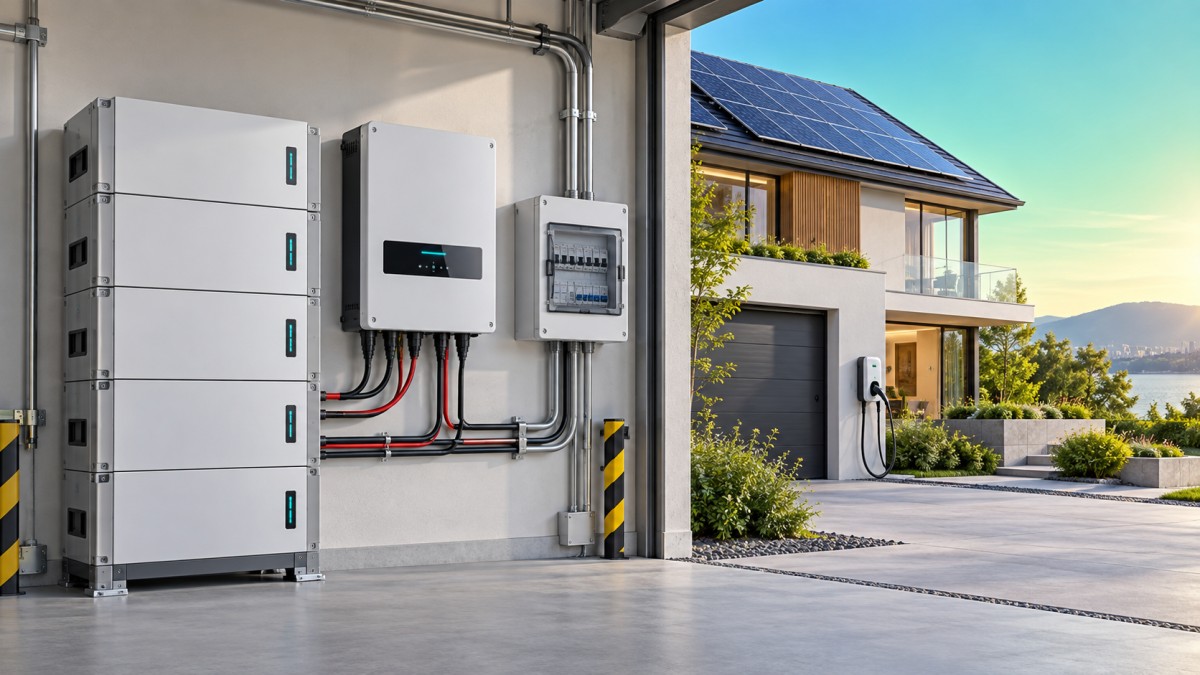
Many homeowners begin with a limited solar array or a modest backup requirement, then add electric vehicles, heat pumps, workshop equipment, or additional family load over time. That makes modularity attractive. Yet “expandable” can mean several different things: adding battery modules to one stack, adding parallel battery units, increasing inverter capacity, adding another inverter, or redesigning the entire backup panel.
These routes are not equally simple. The first addition may be straightforward, while later expansion may require new protection equipment, cabling, wall space, fire-clearance adjustments, utility approval, or an inverter upgrade. If the property is expected to grow, it is usually sensible to assess the electrical architecture before selecting the initial battery size. Spending slightly more on a scalable arrangement at the beginning can avoid a costly redesign later, but only when the growth scenario is realistic.
There is also an age-matching issue. Adding new battery modules to older ones is not always technically or commercially straightforward. Differences in state of health, firmware, manufacturing generation, and battery-management rules can affect what is permitted. This should be confirmed in writing for the specific system configuration, not assumed from general marketing language.
At the system level, the battery management layer is central to safe charging, discharging, temperature monitoring, fault handling, and communication with the inverter. When reviewing modular architectures, evaluators should understand how the BMS coordinates modules and what happens when one component requires service. The practical question is not merely whether modules can be added, but whether the control architecture preserves stable operation across the expanded system.
Compatibility Often Determines the Real Cost of a Residential Storage Project
Residential Energy Storage does not operate in isolation. It must work with the existing or planned solar inverter, PV array, main distribution board, metering arrangement, grid connection, backup loads, and local installation requirements. An apparently economical battery can become a costly project if it requires replacement of recently installed equipment or significant electrical rework.
The first strategic choice is usually between an AC-coupled and DC-coupled arrangement. AC-coupled storage can be practical when adding a battery to an existing solar installation, because the current PV inverter may remain in service. DC-coupled designs can offer a cleaner architecture for a new integrated solar-and-storage project. Neither topology is universally superior. The decision depends on the existing equipment, desired backup behavior, expansion plan, and the contractor’s ability to support the complete system.
Compatibility reviews should also include communications. Battery, inverter, energy meter, monitoring portal, and gateway equipment need reliable coordination. If the system’s performance assumptions depend on software-controlled charging schedules, export limitation, or tariff optimization, ask who supports updates and troubleshooting over the life of the installation. Hardware compatibility without durable service responsibility is not a complete solution.
Companies working across grid energy storage and electrified power systems tend to see this integration issue early. EN New Power Technology (Shandong) Co., Ltd., established in 2020 as a wholly owned subsidiary of a listed company, operates across research and development, manufacturing, and sales for new-energy power systems in off-road machinery and smart-grid energy storage. That kind of cross-system perspective is useful in residential evaluation because battery selection should account for controls, power electronics, service access, and the broader electrical system—not only cell capacity.
A Practical Comparison Framework Before Shortlisting Suppliers
Before requesting quotations, prepare a one-page project brief. It should include annual electricity use if available, representative daily load data, major appliance loads, current and planned solar capacity, outage history, desired backup circuits, electrical phase arrangement, available installation space, and expected future additions such as EV charging. This document makes supplier proposals easier to compare because every bidder is solving the same problem.
Then compare options on the same basis: usable kWh, continuous and surge power, supported backup circuits, charging source, expansion method, full warranty terms, installation scope, monitoring access, and service responsibility. Do not compare a battery-only price with a fully installed backup system price. That is one of the most common sources of misleading procurement decisions.
It is also worth separating “must-have” requirements from “nice-to-have” features. If reliable refrigeration, communications, and lighting during outages are non-negotiable, those loads should drive design. A future pool pump or an occasional high-power appliance may justify expansion planning, but not necessarily immediate oversizing. The best system is often not the largest one; it is the one with clearly defined operating priorities and a credible route to adapt later.
The Better Decision Is Usually the More Specific One
Capacity should be tied to usable energy and actual backed-up loads. Warranty value should be judged by conditions, exclusions, and service practicality rather than years alone. Expansion should be verified at module, inverter, control, and installation levels. Once those three areas are reviewed together, many seemingly similar residential battery offers stop looking equivalent.
A final review with the installer should produce clear answers to a few operational questions: what remains powered during an outage, what cannot run, how the battery will recharge, what can be expanded later, and who is responsible if battery, inverter, or communications equipment does not work as expected. If those answers remain vague, the system design is not ready for a purchasing decision.