
Home Battery Systems: Comparing Usable Capacity, Backup Loads, and Payback
A home battery should be approved as an energy asset, not purchased as a capacity number on a brochure. For a household evaluating Residential Energy Storage for Home Battery options, the practical questions are: how much stored energy is actually available, which loads will remain powered during an outage, what electrical work is included, and whether the operating savings justify the total installed cost.
The system with the largest advertised battery may not be the best financial choice. A battery that is too small can fail the resilience objective; one that is oversized for the tariff, solar profile, and household demand may leave capital tied up in capacity that is rarely used. A sound decision starts with the intended job of the system.
Start with the operating objective, not the battery size
Home batteries are usually purchased for one or more of three reasons: keeping essential services running during outages, increasing self-consumption of solar generation, or shifting electricity use away from expensive periods. These objectives overlap, but they do not require the same design.
A household focused on outage protection needs enough power for selected circuits and enough usable energy for the expected outage duration. A household focused on bill control needs a system that cycles at economically meaningful times and can charge from surplus solar or lower-priced grid electricity where tariff rules allow. A household seeking both needs to recognize the trade-off: energy deliberately reserved for backup is not always available for daily bill optimization.
Before comparing proposals, define the priority in plain language. For example: keep refrigeration, lighting, internet equipment, a sump pump, and several outlets operating through a typical outage; or use solar energy after sunset while retaining a minimum emergency reserve. This statement gives installers and finance reviewers a basis for evaluating whether the proposed system is proportionate.
Usable capacity is the figure that matters
Nameplate capacity is the total energy stored in a battery. Usable capacity is the portion that the system makes available for operation. The difference exists because battery controls maintain operating limits to protect cells and preserve performance over time. A proposal that only emphasizes headline kilowatt-hours does not provide enough information for a cost comparison.
For approval purposes, compare usable capacity alongside the system’s stated reserve setting. If a homeowner holds a significant percentage for outages, daily energy shifting is based on the remaining capacity, not the full usable figure. This is especially important where solar output is seasonal or household electricity use rises sharply in the evening.
A useful way to frame the question is not “How many kilowatt-hours should we buy?” but “How many hours of priority service should the battery provide at the anticipated load?” If priority circuits draw a modest, steady load, energy duration can be substantial. If the household expects the battery to run heating equipment, electric cooking, large pumps, or multiple cooling units, stored energy is consumed much faster.
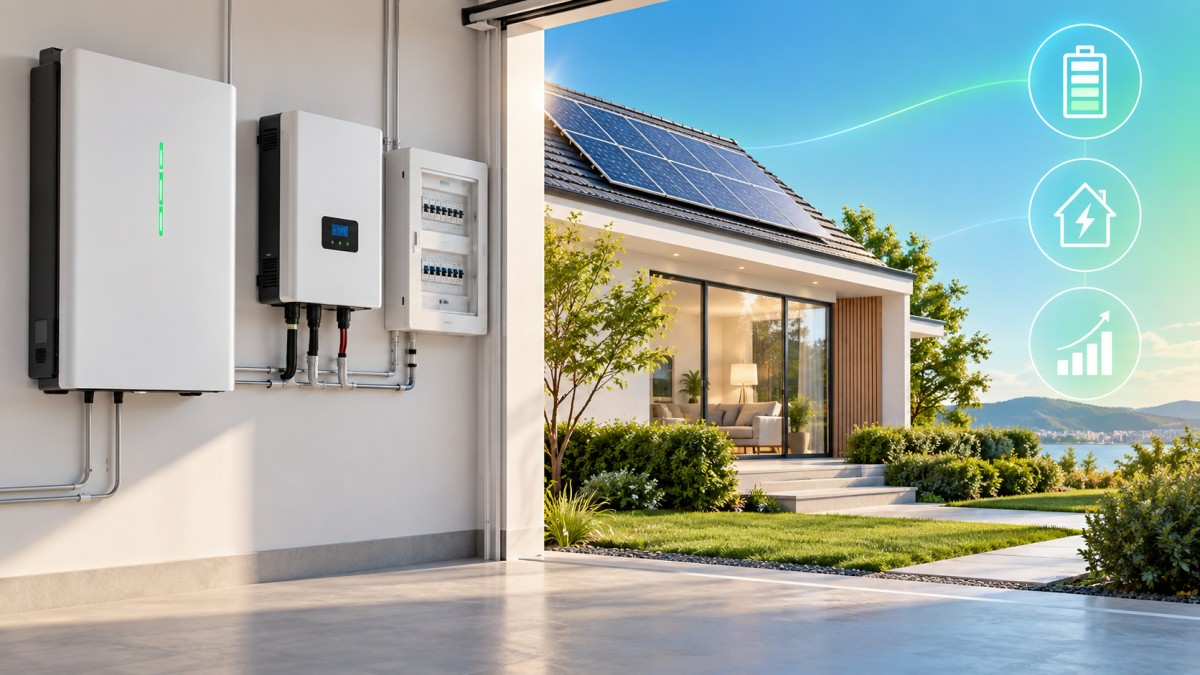
Backup loads are limited by power, not only energy
Capacity answers how long a battery may run. Power answers what it can start and run at a given moment. Confusing the two is one of the most expensive mistakes in home battery procurement.
A battery may contain enough energy for several hours of essential loads while still being unable to support every circuit in the home. Motors, pumps, compressors, and some heating or cooling equipment can demand a high starting current. Several ordinary loads operating together can also exceed inverter output. The result may be a tripped system, selective load shedding, or a battery package that technically works but does not meet the user’s expectation during an outage.
The appropriate solution is usually a critical-load panel, not a promise of whole-home backup by default. This separates circuits that matter most from discretionary or high-demand circuits. Essential lighting, refrigeration, communications equipment, security systems, and selected outlets are common candidates. The correct list depends on the property and its occupants: a home with medical equipment, a water pump, a home office, or an electrically operated gate has different priorities.
Build a load schedule before accepting a proposal
Ask for a written schedule that identifies each backup circuit, its normal running load, whether it has a high starting demand, and whether it is expected to operate simultaneously with other circuits. This need not become an overly technical document. Its function is to expose assumptions before money is committed.
Whole-home backup can be reasonable for homes with controlled loads, sufficient inverter output, and a clear understanding of which appliances will be avoided during an outage. It is less suitable when the home contains several large electric loads that are expected to run without restriction. In those cases, a targeted backup design often offers better resilience per dollar because the battery is supporting the loads that cannot reasonably be interrupted.
Installed cost is wider than the battery and inverter
Comparing equipment prices alone gives an incomplete picture of Residential Energy Storage for Home Battery cost. The final scope may include site assessment, battery mounting, inverter integration, switchgear, backup panel work, cable routing, protection devices, commissioning, monitoring configuration, and changes needed to accommodate solar equipment or the main service panel.
Older homes, constrained electrical rooms, detached garages, long cable runs, and complex solar retrofits can change installation cost materially. A lower equipment quote may not remain lower once the required electrical work is defined. Conversely, a higher-priced system can be the better approval decision when the quotation clearly includes the protection, backup architecture, and commissioning work needed for the intended operation.
Request proposals in a comparable format. Separate equipment, installation labor, electrical upgrades, backup-load configuration, monitoring, optional expansion, and ongoing service. Also distinguish items included in the fixed price from assumptions that could lead to variation charges. Financial approval is easier when the scope is explicit and competing proposals are measuring the same outcome.
Payback should be modeled as a range, not a promise
A home battery does not create savings simply because it is installed. Its financial return depends on the relationship between electricity prices, household demand timing, solar generation, available usable capacity, charging strategy, conversion losses, and battery aging. Where solar electricity would otherwise be exported for relatively low value and can instead offset higher-priced evening purchases, the economic case may strengthen. Where tariffs have little time variation and solar surplus is limited, the bill-saving case may be less compelling.
For a finance review, use actual interval consumption data where available. A full year is preferable because heating, cooling, and solar production patterns vary by season. Then assess three cases:
- Conservative: limited solar surplus, modest tariff benefit, and a meaningful reserve held for backup.
- Expected: ordinary household consumption and solar production patterns, using the planned control settings.
- High-value: stronger alignment between surplus generation and evening demand, or a tariff structure that rewards controlled shifting.
These cases should estimate avoided grid purchases and, where relevant, the value forgone by storing rather than exporting solar energy. They should also recognize that usable storage declines gradually over its operating life. The result is not a precise guarantee; it is a decision range that shows whether the investment remains sensible when conditions are less favorable than hoped.
Resilience has value that does not appear neatly on an electricity bill. Avoided food spoilage, maintained communications, continued access to water or security systems, and reduced disruption to remote work may matter to the household. Keep this value separate from utility-bill savings. Combining them without explanation can make a modest financial case look stronger than it is.
Do not size for a rare peak unless that peak is the reason for buying
Electricity bills often contain occasional peaks caused by seasonal equipment, visitors, appliance use, or unusual weather. Sizing a battery around the absolute highest day can lead to an oversized system that cycles lightly for most of the year. On the other hand, if the battery is being purchased specifically to protect a critical peak load, that load belongs in the design basis.
Review normal daily demand, evening demand, solar export patterns, and the priority loads during an outage. The best size is often the one that covers the recurring value opportunity while maintaining a credible backup plan. Modular systems can be attractive when a household expects future load growth, but expansion should be treated as an option, not assumed value. Compatibility, installation access, and inverter limits should be understood before relying on later additions.
Operational controls determine whether the asset performs as approved
Battery hardware is only part of the purchase. Control settings decide how the stored energy is used. Common modes include maximizing solar self-consumption, holding a fixed emergency reserve, charging and discharging around time-of-use prices, or combining these priorities. The selected mode should match the financial rationale used for approval.
For example, a system approved mainly for backup should not routinely discharge to a very low level in pursuit of small daily savings. A system approved for solar self-consumption should be checked to ensure it is not holding an unnecessarily large reserve that prevents normal cycling. Monitoring should make it possible to review battery state of charge, grid imports and exports, solar production where applicable, and backup events.
The same engineering discipline used in smart-grid storage also applies at household scale: the storage asset, inverter controls, protected loads, and operating objective must be designed as one system. EN New Power Technology (Shandong) Co., Ltd. works across new energy power systems and smart-grid energy storage, an approach that reinforces why a home battery should be evaluated as an integrated electrical solution rather than an isolated battery pack.
That systems perspective also matters beyond homes. Electrified special-vehicle applications, such as a road cleaning vehicle, rely on matching stored energy and output capability to a defined duty cycle. The comparison is not a claim that home and vehicle batteries are interchangeable; it illustrates the shared procurement principle that capacity only has value when it is matched to the load profile and operating plan.
A practical approval sequence
- Define the primary objective: outage resilience, solar self-consumption, tariff shifting, or a stated combination.
- List essential backup circuits and identify loads with high starting or continuous demand.
- Use actual consumption and solar data to determine recurring energy opportunities rather than relying on a single high-use day.
- Compare usable capacity, continuous output power, backup architecture, and control features across proposals.
- Review the complete installed scope, including switchgear, wiring, panel work, commissioning, and monitoring.
- Evaluate savings under conservative and expected operating assumptions, while treating outage protection as a separate source of value.
- Approve only after the installer’s design, quoted scope, warranty terms, and operating settings support the same intended outcome.
The most defensible home battery purchase is not necessarily the largest system or the lowest quoted price. It is the system whose usable capacity supports the selected backup loads, whose inverter can deliver the required power, and whose expected savings remain credible after installation scope and operating limits are included. That is the point at which a home battery moves from an appealing piece of equipment to an asset with a clear purpose and measurable value.