
Calculating the Total Cost of Ownership for Forklift Battery Replacement
Replacement Cost Should Be Treated as a Lifecycle Decision
A forklift battery replacement request often reaches finance as a relatively simple purchase: an existing battery has lost capacity, the warehouse needs another one, and the supplier has issued a quotation. That framing is incomplete. The purchase price matters, but it is rarely the largest source of financial impact over the battery's useful life.
A replacement Forklift Battery affects available truck hours, charging labor, electricity use, maintenance workload, spare-battery requirements, and the likelihood of operational disruption. A lower-priced battery can be the better choice in a lightly used, single-shift facility. In a high-throughput operation, however, a battery that costs more upfront may reduce the need for battery changes, charging-room activity, and replacement purchases sufficiently to produce a lower total cost.
For financial approval, the useful question is not, “Which replacement battery has the lowest quote?” It is, “Which option provides the required productive hours at the lowest credible cost over the planning period?” That requires a cost model built around the site’s operating pattern rather than a generic comparison between battery chemistries.
Start With the Operating Requirement, Not the Battery Price
Before calculating total cost of ownership, define what the forklift must do between charging opportunities. A forklift assigned to occasional pallet movement has a very different energy requirement from one operating continuously in a cold store, loading dock, or multi-shift distribution center.
Finance teams should ask operations for a short, measurable description of use: truck model and voltage, average hours per shift, number of shifts, peak workload periods, lift intensity, attachment use, ambient temperature, existing charging windows, and the operational consequence of an unplanned battery change. The goal is to establish whether the replacement must simply restore existing capability or whether the site is trying to solve an availability problem that the previous battery system exposed.
This distinction prevents a common error: comparing batteries with different usable capacity assumptions. Rated capacity alone does not tell an approver how many productive hours the truck will deliver. Actual run time depends on discharge rate, age, charging practice, temperature, vehicle condition, and how deeply the battery is routinely discharged. A proposal that promises operational coverage should show the assumptions used to reach that conclusion.
For a lead-acid replacement, the question may be whether one battery per truck remains sufficient. For a lithium-based alternative, the question may be whether opportunity charging can reduce or eliminate spare batteries without creating charging congestion. Either result can materially change the capital request.
Build the TCO Model Around Cash Outflows and Productive Time
A practical replacement model does not need excessive complexity, but it should include more than the battery invoice. The calculation should use a consistent planning horizon, usually aligned with the expected service life of the battery or the remaining life of the forklift fleet. Each option should be evaluated over the same number of operating years and the same expected truck utilization.
The basic calculation can be expressed simply:
Total Cost of Ownership = Initial Capital + Energy + Maintenance + Downtime/Handling + Future Replacements + End-of-Life Costs - Residual Value
For an approval decision, this total should be paired with a productivity measure. Useful options include cost per productive forklift hour, cost per shift covered, or cost per pallet movement where reliable operating data exists. Dividing lifecycle cost by a relevant activity measure helps prevent a larger battery from appearing expensive simply because it supports more useful work.
Do Not Treat Labor and Downtime as Minor Costs
Battery handling time is frequently underestimated because it is dispersed across operators, maintenance personnel, and shift supervisors. In a lead-acid fleet with battery changes, the visible event may take only a few minutes. The full cost can include locating a charged battery, moving the truck, using changing equipment, disconnecting and reconnecting safely, recording the change, and returning the depleted unit to charge.
That process also creates secondary costs. A truck may be unavailable during a peak dispatch period. Charging areas require floor space and ventilation management. Staff must maintain safe handling practices around heavy batteries. If charging discipline deteriorates, battery life and available run time can decline before the finance model expected it.
These costs do not automatically justify a chemistry change. A single-shift operation with ample overnight charging and low labor pressure may have little economic reason to replace a conventional system early. The logic changes when the facility needs trucks available over multiple shifts, has limited room for spare batteries, or repeatedly loses time to battery changes and charging queues.
Finance should therefore request a site-specific estimate of annual battery-related labor hours. It should separate planned work, such as watering and inspections, from unplanned work, such as service calls and recovery from insufficient charge. An estimate based on actual shift routines is more useful than a generic labor percentage applied to the battery price.
Compare Lead-Acid and Lithium Options on the Same Operating Assumptions
The most consequential replacement decision is often whether to retain lead-acid batteries or move to lithium-ion technology, commonly lithium iron phosphate in industrial applications. The answer is dependent on the duty cycle and facility design.
Lead-acid batteries may remain financially appropriate where trucks work predictable, limited hours and can receive a full charge during non-operating periods. The equipment and maintenance practices may already be established, and the initial capital requirement is often easier to approve. But the financial case must include the cost of watering, battery room activity, and the operational impact of charging patterns. Repeated partial charging or deep discharge outside the intended regime can weaken the expected service life.
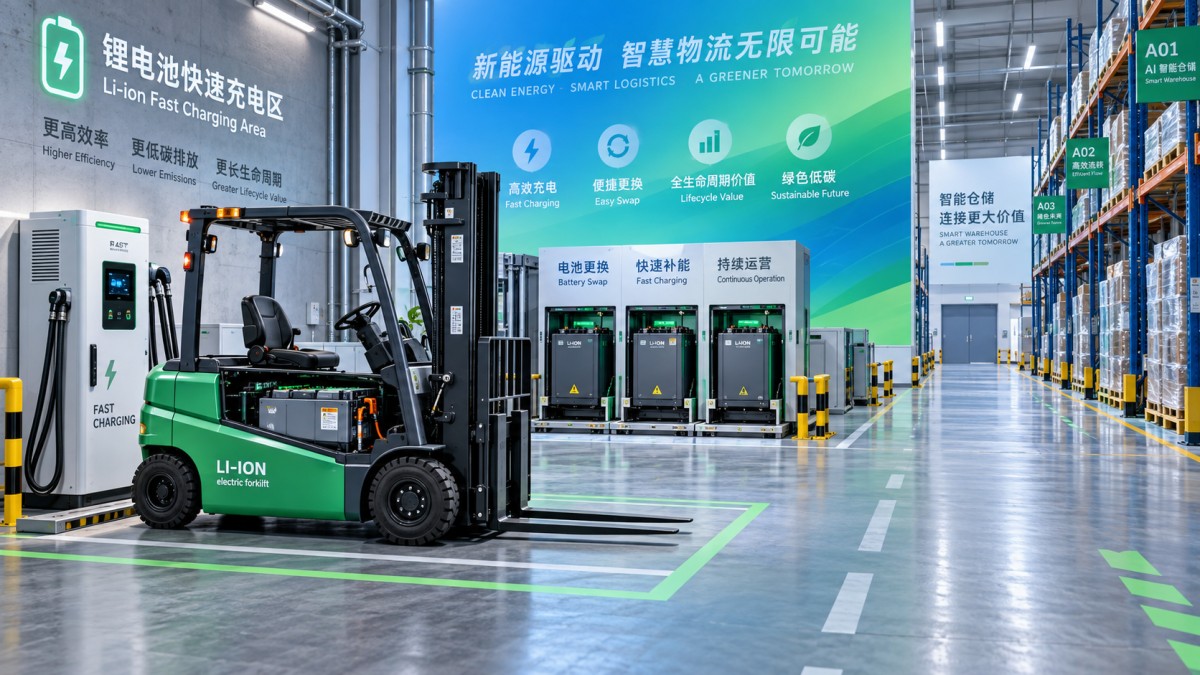
Lithium-based systems generally change the operating model. Faster charging and opportunity charging can support higher truck availability, while reduced routine battery maintenance can lower direct labor. The initial purchase price and potential charger or electrical upgrades, however, are real costs that should not be diluted by optimistic productivity claims. The expected savings depend on whether the facility can use charging breaks consistently without interfering with work.
A strong comparison uses the same truck workload, energy tariff, planning period, and downtime valuation for both options. It also tests a conservative scenario. For example, what happens if opportunity charging occurs less often than planned, electricity prices change during peak hours, or the site still retains spare capacity for operational resilience? If the financial benefit disappears under a modestly conservative assumption, the proposal may be relying on operating behavior that is difficult to sustain.
Infrastructure Is Part of the Battery Purchase
Battery replacement proposals sometimes assume existing chargers, electrical supply, connectors, and charging locations will remain suitable. That assumption should be checked before approval. A new battery may require a compatible charger, different communications capability, revised cable sizing, or changes to the charging schedule. High-power charging can also change demand patterns at the facility.
The finance review should identify whether infrastructure spending is a one-time enabling cost, a broader fleet investment, or an expense caused by the specific replacement. This classification matters when only part of a fleet is being converted. Charging infrastructure that will support future trucks may deserve a separate capital case rather than being loaded entirely onto the first battery purchase.
Safety and environmental requirements should be evaluated in the same review. For lead-acid systems, charging-area ventilation, acid handling, and spill controls can affect operating cost. For lithium systems, procurement should examine enclosure protection, battery management functions, temperature management, fault response procedures, and compatibility with the forklift. These are not technical details to leave solely to the supplier; they affect asset availability, insurance exposure, maintenance procedures, and the credibility of the lifecycle assumptions.
Battery specifications developed for other off-road equipment illustrate why application fit matters. For example, liquid cooling and IP67 protection found in solutions such as Electric Mini Excavator Products may be relevant where machinery faces vibration, water, dust, or harsh outdoor duty. They should not be treated as automatic requirements for an indoor forklift fleet. A finance approver should pay for the protection and thermal capability the operating environment requires, rather than approving features that do not change risk or uptime.
Validate Warranty Terms Against the Financial Model
Warranty language can create false confidence if it is not connected to the intended operating profile. A battery warranty may contain conditions related to charging practices, temperature exposure, depth of discharge, maintenance records, or authorized service. The financial model should not assume a full replacement recovery unless the likely failure mode is covered and the operating team can meet those conditions.
Review the warranty in commercial terms: what is covered, what evidence is required, whether labor and transport are included, whether coverage is prorated, and how quickly a replacement unit can be supplied. A long warranty period has limited value if a failed battery leaves a critical truck idle for an extended period or if the fleet has no contingency capacity.
It is also prudent to distinguish between battery failure and gradual loss of usable capacity. A battery can remain functional while no longer supporting the required shift length. If the operation depends on a minimum run time, that threshold should be stated in the procurement specification and, where possible, reflected in supplier commitments.
Use Sensitivity Analysis Before Approving the Premium Option
A total cost model is most useful when it shows which assumptions drive the result. Finance does not need to predict every variable perfectly; it needs to know where the decision is fragile.
- Test lower and higher annual operating hours.
- Test the effect of missed opportunity-charging windows or increased battery-change frequency.
- Separate peak and off-peak electricity costs where the site’s tariff makes that relevant.
- Apply different battery life assumptions rather than relying only on the supplier’s expected cycle life.
- Include a realistic value for forklift downtime during the busiest operating periods.
- Model the effect of retaining a spare battery or spare truck for continuity.
If a higher-capital option remains favorable across these conditions, the approval case is robust. If it only wins under the most optimistic utilization and labor assumptions, it may be better to pursue a lower-risk replacement or first improve charging discipline and fleet scheduling.
The Approval Should Specify the Outcome to Be Delivered
The final approval should describe more than the battery type and purchase price. It should state the required operating coverage, compatible charging arrangement, expected maintenance responsibility, warranty conditions, implementation timing, and the measures that will be reviewed after installation. This turns the purchase from an equipment transaction into an accountable operating decision.
For many facilities, the best replacement is the one that restores reliable operation at the lowest lifecycle cost with minimal change to established processes. For higher-utilization fleets, the better choice may involve greater upfront capital but fewer interruptions, less battery handling, and a more predictable operating budget. The right conclusion comes from matching the energy system to the work pattern, then making every material cost visible before the purchase order is approved.